

Selling During a Market Crash: 5 Costly Lessons Every Investor Should Know

Selling during a market crash: investor journey from ₹60 lakh to ₹40 lakh and missed recovery
A visual story showing how panic selling during a market crash can lead to missed recovery and future compounding opportunities.

Selling during a market crash can feel like the safest decision in the moment. But when markets recover, investors who sold in panic can sometimes find themselves facing a different problem: how and when to get back in.

This is the story of Arjun, a fictional investor based on a situation many Delhi NCR investors can relate to. One five-minute decision during a period of market panic changed the way he approached his long-term investment journey.

The Setup: A Normal Long-Term Investment

In 2010, Arjun invested ₹25 lakh into a diversified equity portfolio with a simple goal: build wealth over the next 15–20 years and support his family’s future needs.

He wasn’t trading or looking for quick profits. For years, his plan worked reasonably well. His portfolio went through good years, bad years, and a few uncomfortable corrections.

Arjun understood that markets don’t move in a straight line, so he stayed invested. Then came a market fall that tested that confidence.

For investors who want to understand how different investment structures work, our guide on Mutual Funds vs PMS and AIFs explains the key differences between these options.

When ₹60 Lakh Started Looking Like ₹40 Lakh

At its peak, Arjun’s portfolio had grown to roughly ₹60 lakh.

Then the market entered a sharp decline. The value moved from ₹55 lakh to ₹48 lakh, then ₹42 lakh, and eventually ₹40 lakh.

Almost ₹20 lakh had disappeared from the portfolio value.

Arjun knew, in theory, that equity markets could fall. But watching his own money decline day after day felt very different from reading about market volatility in an article—the numbers started becoming emotional.

Market volatility is a normal part of investing, but the way an investor responds to it can have a major impact on their investment journey. SEBI’s investor-education material explains volatility risk and discusses diversification as one way investors can manage different investment risks. (SEBI Investor)

The Moment of Selling During a Market Crash

One evening, Arjun called his advisor and said,

“I don’t want to lose any more.”

He wasn’t asking what fund to buy next—he had already made up his mind.

Despite being reminded about his long-term goal, Arjun sold his remaining equity investments and moved ₹40 lakh into cash.

For the first time in weeks, he felt relieved.

At least, he thought, the portfolio couldn’t fall any further.

Selling during a market crash felt like the safest decision at that moment.

But the difficult part came later.

What Happened After He Sold

The market eventually stopped falling—and started recovering.

Arjun told himself he would invest again “when things became clearer.”

But clarity didn’t arrive on his preferred schedule.

The market recovered 10%, then another 10%. Arjun continued waiting for a clear signal that it was safe to return.

By the time the market looked comfortable again, prices had already moved significantly higher, and buying back in suddenly felt expensive.

So he waited for another correction—one that didn’t arrive when he expected it.

Months became years, and the investor who had successfully avoided the fall ended up missing a significant part of the recovery.

NISM investor-education material similarly highlights the role of disciplined investing, long-term planning, and avoiding emotion-driven decisions during market fluctuations. (NISM)

The Two Paths: Staying Invested vs Staying in Cash

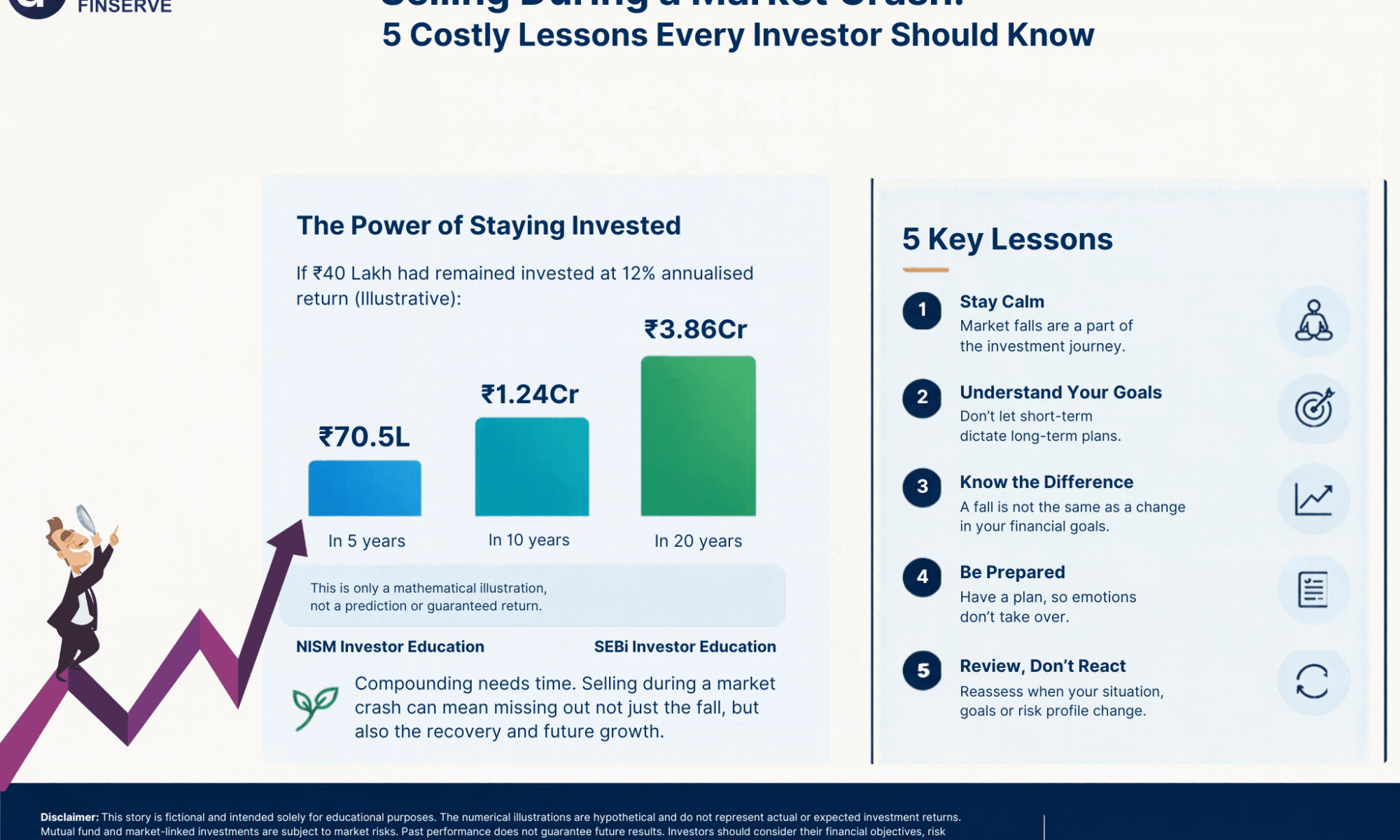
If Arjun’s ₹40 lakh had remained invested and earned an illustrative 12% annualized return, it could have grown to approximately ₹70.5 lakh in 5 years, ₹1.24 crore in 10 years, and ₹3.86 crore in 20 years.

(This is only a mathematical illustration, not a prediction or guaranteed return.)

Instead, if the ₹40 lakh simply remained as cash, it would still be approximately ₹40 lakh, ignoring interest, inflation, and taxes.

The important point is that compounding needs time—when an investor sells during a market crash, they may not just miss the fall, they can also miss the recovery and the future compounding that follows.

For more on how investment behavior can affect long-term outcomes, investors can also explore NISM’s educational material on disciplined investing and staying invested through market fluctuations. (NISM)

The Real Cost Wasn’t the Fall—It Was the Recovery He Missed

Consider an even simpler example.

Suppose an investor has ₹1 crore and the market falls by 30%.

The portfolio becomes ₹70 lakh.

To get from ₹70 lakh back to ₹1 crore, the portfolio needs to rise by approximately 42.9%, not 30%.

Now imagine the investor sells at ₹70 lakh.

If the market subsequently rises by 50%, the investor who stayed invested would have approximately ₹1.05 crore, while the investor who sold would still have ₹70 lakh if that money remained in cash.

This doesn’t mean investors should never sell—it simply shows why selling during a market crash can create another challenge: participating in the recovery.

Should You Never Sell?

Absolutely not—that would be the wrong lesson to take from this story.

There can be perfectly valid reasons to sell or reduce an investment: your financial goal has changed, your investment horizon has become shorter, your risk tolerance has changed, your circumstances are different, or the underlying investment case no longer fits your original plan.

These situations deserve a proper review.

The bigger concern is selling purely because the market is falling, without anything about your actual plan having changed.

Before selling during a market crash, ask yourself:

“If the market hadn’t fallen, would I still believe this portfolio is right for my long-term goal?”

If the answer is yes, your goal hasn’t changed—only the market value has.

That distinction can be important.

If you’re reviewing your mutual fund portfolio, you may also find our guide on Why Is My Mutual Fund Underperforming? useful for understanding whether underperformance is temporary or something that requires a deeper review.

GCIC Finserve’s Take

Arjun’s story is fictional, but the behavior behind it is something many Delhi NCR investors can relate to during difficult market cycles.

At GCIC Finserve, AMFI-registered Mutual Fund Distributor (ARN-272705), we believe investment decisions should be reviewed in the context of your financial goals, risk profile, investment horizon, and underlying investments—not simply because markets have temporarily fallen.

A market correction can be uncomfortable, but making a long-term decision during a short-term period of fear can have consequences.

Before selling during a market crash, take a step back and review whether your original plan has actually changed.

Investors can also refer to NISM’s investor-education resources for information on disciplined investing, financial planning, and understanding market fluctuations. NISM’s recent investor-education material specifically highlights disciplined investing and avoiding emotional decision-making during market cycles. (NISM)

For additional information about mutual fund risks, investors can refer to AMFI’s investor education resources. AMFI notes that mutual fund investments are subject to market-related risks and that returns are not guaranteed. (AMFI India)

If you’re unsure whether your portfolio still fits your goals, connect with GCIC Finserve or consider discussing your situation with a qualified financial professional before making a major investment decision.

FAQs

Q1. Is selling during a market crash ever a good idea?

It can be appropriate when your financial goals, investment horizon, risk tolerance, or the underlying investment have genuinely changed.

Selling purely because of short-term market fear, however, can make it difficult to participate in a subsequent recovery.

Q2. How much does a portfolio need to recover after a 30% fall?

A portfolio that falls 30% needs approximately a 42.9% gain to return to its original value.

Q3. Why do investors often miss the recovery after selling?

Markets don’t usually provide a clear signal telling investors exactly when the recovery has begun.

Investors waiting for “confirmation” may re-enter only after prices have already moved higher.

Q4. What should I ask myself before selling during a market crash?

Ask whether your original investment goal, time horizon, and reason for investing have changed.

If they haven’t, consider whether the decision is being driven mainly by short-term market fear.

Q5. Should I stop investing when the market falls?

There is no single answer for every investor.

The appropriate approach depends on your goals, risk profile, time horizon, and financial circumstances.

A market fall by itself does not automatically mean an existing investment plan is no longer suitable.

Final Word

A market fall is an event. Your response to it is a decision—and the two don’t necessarily have to be treated as the same thing.

Arjun didn’t need to predict the market bottom or buy at the lowest possible price.

He simply needed to understand the difference between a temporary market decline and a genuine change in his plan.

Sometimes, the biggest cost of selling during a market crash isn’t the loss you lock in—it’s the recovery and future compounding you may miss.

Disclaimer: This story is fictional and intended solely for educational purposes. The numerical illustrations are hypothetical and do not represent actual or expected investment returns. Mutual fund and market-linked investments are subject to market risks. Past performance does not guarantee future results. Investors should consider their financial objectives, risk profile, and investment horizon before making investment decisions. Please consult a qualified financial professional for advice specific to your circumstances.

Mutual Funds vs PMS and AIFs: 5 Key Differences Every Investor Should Know

Mutual funds vs PMS and AIFs: key investment differences
Mutual Funds vs PMS and AIFs – understand the key differences in investment structure, customisation, risk, liquidity and costs.

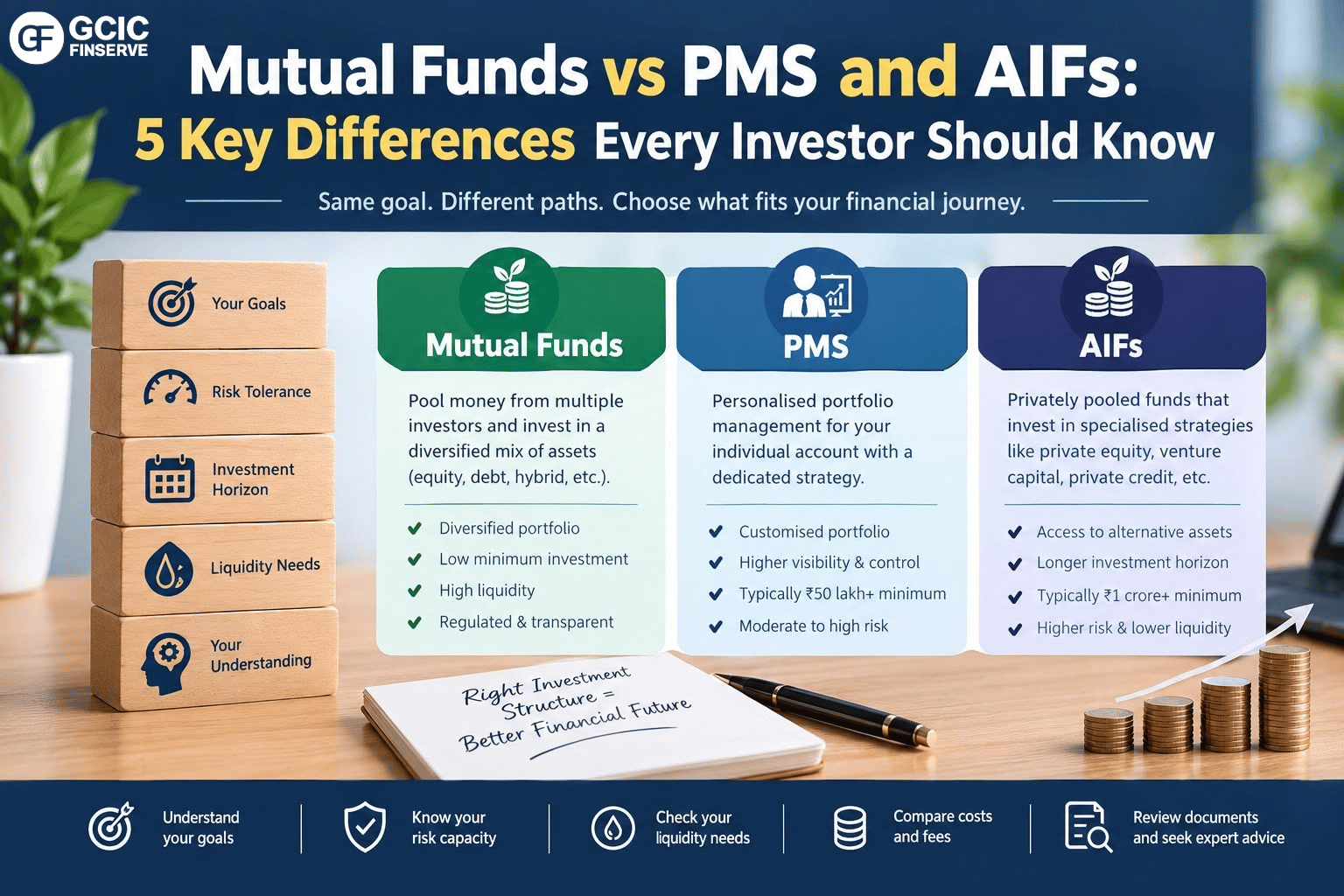
As an investment portfolio grows, many investors begin comparing mutual funds vs PMS and AIFs. Mutual funds, Portfolio Management Services (PMS), and Alternative Investment Funds (AIFs) offer different ways to invest, manage risk, and access financial opportunities.

However, a more specialized investment structure is not automatically better. The right choice depends on your financial goals, risk tolerance, investment horizon, liquidity requirements, and level of understanding.

Three Investment Structures Explained Simply

Mutual Funds

A mutual fund pools money from multiple investors. The fund manager invests this money according to the scheme’s stated objective.

Mutual funds may invest in equity, debt, hybrid instruments, and other permitted securities. Investors own units of the scheme rather than directly owning every security in the portfolio.

Portfolio Management Services (PMS)

PMS involves managing investments in an investor’s individual account according to an agreed strategy.

Depending on the arrangement, PMS may provide greater portfolio visibility and customization. However, the strategy, costs, concentration, and risks vary between providers.

Alternative Investment Funds (AIFs)

AIFs are privately pooled investment vehicles that follow specific investment strategies. Depending on the category and mandate, an AIF may invest in private equity, venture capital, private credit, or other permitted investments.

AIFs can involve longer investment horizons, limited liquidity, and specialised risks.

Mutual Funds vs PMS and AIFs: 5 Key Differences

1. Ownership and Investment Structure

In a mutual fund, investors own units of a common scheme.

In PMS, the underlying securities are generally held in the investor’s individual account, subject to the service arrangement.

In an AIF, investors participate in a pooled investment structure and follow the fund’s defined strategy.

The ownership structure affects transparency, control, reporting, and how investments are managed.

2. Portfolio Customisation

Mutual funds generally follow one investment strategy for all investors in the scheme.

PMS can offer greater customisation because the portfolio is managed for an individual investor. However, the degree of customisation depends on the specific PMS strategy and agreement.

AIF investments usually follow a common strategy defined in the fund’s documents rather than being individually customised for every investor.

More customisation does not necessarily mean lower risk. A concentrated portfolio may increase exposure to specific companies, sectors, or investment themes.

3. Investment Opportunities

Mutual funds provide access to various permitted asset classes, including equity, debt, and hybrid investments.

PMS strategies may focus on listed equities, debt, or other permitted securities, depending on the portfolio manager’s mandate.

AIFs may provide access to specialised opportunities such as:

  • Private equity
  • Venture capital
  • Private credit
  • Specialised investment strategies
  • Other permitted alternative investments

The availability of these opportunities depends on the fund’s category, mandate, and regulatory framework.

4. Liquidity and Investment Horizon

Liquidity refers to how easily an investment can be converted into cash.

Mutual funds generally offer relatively convenient purchase and redemption mechanisms, although the applicable rules vary by scheme.

PMS liquidity depends on the securities held and the investment strategy.

AIFs may have lock-in periods, limited exit opportunities, or longer investment commitments, particularly when they invest in private or less-liquid assets.

Before investing, understand:

  • Lock-in period
  • Exit conditions
  • Redemption process
  • Possible exit charges
  • Expected investment duration

5. Minimum Investment, Costs and Risks

Mutual funds are available across a wide range of investment amounts, depending on the scheme.

For PMS, the general regulatory minimum investment requirement is ₹50 lakh, subject to applicable regulations and exceptions.

For AIFs, the general minimum investment requirement is ₹1 crore, with specific exceptions, including provisions applicable to accredited investors. Always verify the current regulatory requirements before investing.

Costs also differ between these structures. Investors should review:

  • Management fees
  • Expense ratios
  • Performance-linked fees
  • Exit charges
  • Other applicable expenses

Higher fees or greater complexity do not guarantee better investment performance.

When Mutual Funds May Be Suitable

Mutual funds may be suitable for investors looking for diversified exposure through a professionally managed structure.

They can be considered for goals such as:

  • Long-term wealth creation
  • Retirement planning
  • Children’s education
  • Systematic investing
  • Asset allocation

The suitability of a mutual fund depends on its investment objective, risk level, costs, and alignment with the investor’s goals.

A growing portfolio does not automatically require an investor to shift away from mutual funds.

When PMS May Be Considered

PMS may be considered by investors who require a more personalised investment approach and understand the associated risks and costs.

Potential features may include:

  • Individual portfolio management
  • Greater visibility of holdings
  • Strategy-based customisation
  • Direct ownership of underlying securities

However, PMS portfolios may be more concentrated and can experience significant fluctuations. Investors should carefully evaluate the portfolio manager, strategy, fees, risk management process, and track record.

Past performance does not guarantee future results.

When an AIF May Be Suitable

AIFs may be considered by eligible investors seeking exposure to specialised investment strategies or asset classes.

Depending on the AIF category, investments may involve private companies, venture capital, private credit, or other alternative assets.

Before investing, assess:

  • Investment strategy
  • Fund category
  • Lock-in period
  • Liquidity risks
  • Capital commitment
  • Fees and expenses
  • Risk disclosures
  • Exit and distribution terms

An AIF should be selected based on its specific investment purpose rather than its exclusive or sophisticated image.

Is PMS or an AIF Automatically Better Than a Mutual Fund?

No investment structure guarantees superior returns.

A mutual fund, PMS strategy, or AIF may perform differently depending on market conditions, investment decisions, costs, and portfolio construction.

Instead of asking which product is more sophisticated, consider:

What specific purpose will this investment serve in my portfolio?

The investment structure should match your financial goals, risk capacity, liquidity needs, and investment knowledge.

5 Questions to Ask Before Investing

Before moving money from mutual funds into PMS or AIFs, ask yourself:

  1. What financial goal am I trying to achieve?
  2. What additional benefit does this investment provide?
  3. How much liquidity am I giving up?
  4. Do I understand all costs and risks?
  5. Am I choosing the strategy or simply following recent returns?

A detailed review can help you understand whether the proposed investment fits your overall financial plan.

GCIC Finserve’s Perspective

At GCIC Finserve, we help investors understand different investment structures based on their financial goals, risk profile, and liquidity requirements.

As an AMFI-registered Mutual Fund Distributor (ARN-272705), AMFI-registered SIF Distributor, and PMS Distributor (APRN-08140), our team helps investors evaluate the role of mutual funds, PMS, and AIFs within their overall investment strategy.

Before making an investment decision, review the relevant product documents and understand the risks, fees, and applicable eligibility requirements.

Contact GCIC Finserve to discuss your investment requirements.

Frequently Asked Questions

Q1. Is PMS better than mutual funds?

Not automatically. PMS may offer greater customization, but it can involve different costs, concentration levels, and risks. Suitability depends on the investor’s requirements.

Q2. What is the minimum investment for PMS in India?

The general minimum investment requirement for PMS is ₹50 lakh, subject to applicable regulations and exceptions.

Q3. What is the minimum investment for AIFs?

The general minimum investment requirement for AIFs is ₹1 crore. Certain exceptions may apply, including provisions for accredited investors. Confirm the current rules before investing.

Q4. Can I invest in mutual funds, PMS, and AIFs together?

Yes, an investor may use different investment structures where appropriate. Each investment should have a clearly defined purpose and fit the overall portfolio strategy.

Q5. Should high-net-worth investors automatically move to PMS or AIFs?

No. A larger portfolio does not automatically make a complex investment product suitable. Goals, risk tolerance, liquidity, costs, and investment knowledge should be evaluated first.

Final Word

The comparison of mutual funds vs PMS and AIFs is not about choosing the most sophisticated product. It is about understanding how each structure works and whether it supports your financial goals.

Mutual funds, PMS, and AIFs have different features, costs, risks, and liquidity conditions. Evaluate each option carefully, review the relevant documents, and make decisions based on your individual circumstances.

Disclaimer: This article is intended solely for educational and informational purposes and should not be construed as investment advice. Investments in mutual funds, PMS, and AIFs are subject to market and other risks. Please review all relevant product and scheme documents and consult an appropriately registered professional before investing.

Why Is My Mutual Fund Underperforming? 5 Real Reasons Every Delhi NCR Investor Should Understand

Why is my mutual fund underperforming – 5 real reasons explained
Should you invest in 10 mutual funds portfolio diversification
More mutual funds do not always mean better diversification.

Why is my mutual fund underperforming? It’s the question that hits the moment you spot a friend’s fund or a WhatsApp forward showing higher returns than your own. Across Delhi NCR, this is one of the most common triggers for investors to impulsively switch funds, often without actually understanding what’s behind the gap. Before you make that call, it helps to know that a fund can deliver positive returns and still technically be “underperforming”—and that alone isn’t always a red flag.

What Does “Underperforming” Actually Mean?

Underperformance simply means a fund has delivered lower returns than an appropriate reference point—its benchmark, its category, or a comparable peer—over a specific period. If your fund returned 10% while its benchmark returned 14%, that’s a 4-point gap. But looking at just one period can be misleading, since different investment strategies perform differently across market cycles. A fund trailing today may lead tomorrow once conditions shift—which is exactly why understanding why my mutual fund is underperforming matters more than reacting to a single number.

5 Real Reasons a Mutual Fund Can Underperform

1. Its Investment Style Is Temporarily Out of Favor

A value-oriented fund can lag when growth stocks are leading the market, and a defensive portfolio may not fully participate in a sharp rally. This doesn’t mean the fund manager has erred—it may simply be positioned differently from what the market is currently rewarding.

2. It’s Going Through a Difficult Market Cycle

If the sectors a fund holds significant exposure to fall out of favor, its returns can trail benchmarks and peers for a stretch—particularly relevant for actively managed funds whose positioning differs meaningfully from an index.

3. The Fund Manager’s Calls Haven’t Worked Out

Active management means making decisions that differ from the benchmark. Some work, some don’t. If a fund manager’s decisions consistently fail to add value over a meaningful period, that’s when persistent underperformance deserves closer investigation.

4. Higher Costs Are Eating Into Returns

Expenses reduce what actually reaches investors. Two funds with near-identical portfolios can produce different investor returns purely due to differences in expense ratios—which is exactly why performance should be judged after costs, not just on paper.

5. The Fund Itself Has Changed

Fund managers change, investment processes evolve, and portfolios can end up looking quite different from what you originally signed up for. If the reason you picked the fund no longer holds true, that’s worth attention—even before returns reflect the shift.

Stop Comparing Every Fund to the Nifty

One of the biggest mistakes behind “why is my mutual fund underperforming” panic is comparing every scheme directly to the Nifty 50. A small-cap fund, a debt fund, and a large-cap fund all have completely different mandates, so their performance should be judged against the appropriate benchmark and category—not a single headline index. The real question isn’t “did my fund beat the market?” It’s “Did my fund perform reasonably well relative to what it’s actually designed to compete with?”

How Long Should You Wait Before Judging a Fund?

There’s no universal timeframe that fits every fund. Short-term performance is heavily influenced by market conditions, so a few weak months — or even a year — may not say much about a long-term strategy’s quality. A more meaningful review looks at performance across different market cycles and an appropriate investment horizon. According to AMFI India’s investor education resources, evaluating a fund against its category and benchmark over a longer, relevant period gives a far more accurate picture than a single year’s snapshot.

Should You Switch Your Mutual Fund?

Not simply because another fund performed better recently. Switching purely on recent performance often traps investors in a costly cycle—selling a fund after weakness and buying another right after it has already run up. Instead, first understand why your fund underperformed and whether that reason is likely to persist. If its strategy, management, and risk profile remain appropriate, temporary underperformance may not require any action at all. A review becomes genuinely worthwhile when underperformance is persistent, hard to explain, or accompanied by real changes in fund management or strategy.

GCIC Finserve’s Take for Delhi NCR Investors

At GCIC Finserve, when Delhi NCR clients ask, “Why is my mutual fund underperforming?” we don’t jump straight to a switch—we look at the fund’s benchmark-relative performance, category consistency, portfolio positioning, and whether it’s still serving its original purpose in the portfolio. As an AMFI-registered Mutual Fund Distributor (ARN-272705), our team helps you separate a fund that genuinely needs replacing from one that’s simply going through a normal market cycle.

FAQs

Q1. Why is my mutual fund underperforming the market? It could be due to its investment style being out of favor, sector exposure, costs, fund manager decisions, or changes in the fund’s strategy—not necessarily poor management.

Q2. Should I sell a mutual fund after one year of underperformance? Not necessarily. One year can reflect normal market cycles rather than a genuine problem—compare it against its appropriate benchmark and category first.

Q3. Should I switch to whichever fund has the highest recent returns? Not automatically. Chasing recent performance often means buying high after a fund has already run up—evaluate based on strategy and suitability instead.

Q4. What should I check before replacing an underperforming fund? Its benchmark and category performance, consistency across periods, portfolio positioning, costs, and whether it still fits your original goal and risk profile.

Final Word

The next time you catch yourself asking, “Why is my mutual fund underperforming?” resist the urge to switch immediately. Understand the reason first—market cycle, style, costs, or a genuine change in the fund—and only then decide if action is actually needed. A fund doesn’t need to top the charts every year to remain the right investment for you.


Disclaimer: This article is intended solely for educational and informational purposes and should not be construed as investment advice. Mutual fund investments are subject to market risks. Please review scheme-related documents and consult a registered advisor before investing.

Should You Invest in 10 Mutual Funds? 5 Smart Truths Every Delhi NCR Investor Should Know

Should you invest in 10 mutual funds portfolio diversification
More mutual funds do not always mean better diversification.

Should you invest in 10 mutual funds to achieve proper diversification?
This is a common question among Delhi NCR investors who started with one or two SIPs and gradually added more funds.

One mid-cap fund here, one flexi-cap fund there, and another scheme recommended by a friend can eventually turn into a portfolio of ten or more mutual funds.

But owning ten mutual funds and being genuinely diversified are not necessarily the same thing.

The important question is not simply how many funds you own. It is whether each fund has a clear purpose and contributes meaningfully to your overall financial goals.

1. Why the Number of Funds Isn’t the Real Question

Diversification depends on what your investments actually hold, rather than the number of schemes in your portfolio.

For example, three large-cap mutual funds may invest in many of the same companies. Although the fund names and fund managers are different, their underlying holdings may overlap significantly.

This means a portfolio can appear diversified while still having considerable exposure to the same stocks or sectors.

Before adding another mutual fund, consider:

  • Underlying stock holdings
  • Overall asset allocation
  • Investment time horizon
  • Risk tolerance
  • The purpose of each fund
  • Your financial goals

Instead of focusing only on the number of schemes, understand how each investment fits into your complete portfolio.

2. How Mutual Fund Portfolios Quietly Become Overcrowded

Most investors do not intentionally decide to create a portfolio of ten mutual funds.

It often happens gradually. A fund generates strong recent returns, a new category becomes popular, or someone recommends another SIP. Over time, more schemes are added without reviewing the existing investments.

This can create two common challenges.

Fund Overlap

Different mutual funds may hold similar companies or sectors. This can reduce the diversification benefit you expected from owning multiple schemes.

Portfolio Complexity

When you own too many funds, it may become difficult to understand:

  • Where your money is invested
  • Which funds serve similar purposes
  • Whether your asset allocation remains suitable
  • Which investments need periodic review

A larger portfolio is not automatically a better portfolio. Clarity and suitability matter.

3. Should You Invest in 10 Mutual Funds?

There is no universal number of mutual funds that every investor should own.

The appropriate number depends on factors such as your investment amount, financial goals, risk profile, time horizon, and the role of each scheme.

An investor with multiple financial goals and a diversified asset allocation may have different requirements from someone who is starting their first SIP.

For many investors with relatively straightforward goals, adding funds only to increase the number of schemes may not provide meaningful benefits.

Before investing in another mutual fund, ask yourself:

What does this fund add to my existing portfolio that I do not already have?

If you cannot clearly explain its purpose, take time to review your existing investments before adding another scheme.

4. A Simple Test Before Adding Another Fund

Before deciding whether you should invest in 10 mutual funds or maintain a smaller portfolio, ask yourself these three questions.

1. Does the Fund Have a Different Purpose?

Does the new fund serve a different investment objective from your existing schemes?

Avoid adding a fund merely because it belongs to a different category or has recently delivered strong returns.

2. Does It Improve Diversification?

Review the fund’s underlying holdings and sector exposure. Different fund names do not necessarily mean different investments.

3. Would You Choose It Today?

Imagine that you were building your portfolio from scratch.

Would you still select this fund based on your current goals, risk profile, and investment strategy?

This question can help identify investments that remain in a portfolio simply because they were purchased in the past.

5. What If You Already Own 10 or More Funds?

If you already own ten or more mutual funds, do not rush to sell them only because the number appears high.

Instead, begin with a structured portfolio review.

Step 1: List All Your Funds

Prepare a list of your mutual funds, investment amounts, SIP contributions, and financial goals.

Step 2: Understand Each Fund’s Role

Identify whether each scheme is intended for long-term growth, a specific goal, diversification, or another purpose.

Step 3: Review Portfolio Overlap

Check whether multiple funds have similar holdings, sector exposure, or investment objectives.

Step 4: Review Your Asset Allocation

Understand your overall exposure to equity, debt, and other asset classes according to your financial needs and risk profile.

Step 5: Consider Consolidation Carefully

After reviewing the portfolio, you may identify opportunities to simplify your investments. Any decision to switch or redeem should consider factors such as taxes, exit loads, investment goals, and suitability.

The objective should not be reaching an arbitrary number of funds. The objective should be creating a portfolio that is understandable and aligned with your financial goals.

6. GCIC Finserve’s Approach for Delhi NCR Investors

At GCIC Finserve, we believe the right question is not simply, “Should you invest in 10 mutual funds?”

The more important question is:

Does every mutual fund in your portfolio have a clear reason to be there?

As an AMFI-registered Mutual Fund Distributor (ARN-272705), GCIC Finserve helps investors understand their portfolio structure, identify potential overlap, and review investment choices in the context of their financial goals.

Investors in South Delhi, Gurgaon, Noida, Ghaziabad, and other parts of Delhi NCR can consider reviewing their existing portfolio before adding another scheme.

You can explore our Financial Assessment page or visit our Contact Us page to learn more about the available services.

For investor education and mutual fund-related resources, visit AMFI India.

7. Frequently Asked Questions

Q1. Should you invest in 10 mutual funds?

It depends on your financial goals, risk profile, asset allocation, and the purpose of each fund. The number of schemes alone does not determine diversification.

Q2. How many mutual funds should I own?

There is no fixed number that applies to every investor. Choose investments based on your goals and whether each fund serves a distinct purpose.

Q3. Can different mutual funds hold the same stocks?

Yes. Different mutual funds can hold many of the same companies. This is known as portfolio overlap.

Q4. Should I sell my mutual funds if I own 10 or more?

Not automatically. Review each fund’s role, holdings, costs, tax implications, and suitability before making any decision.

Q5. How can I identify mutual fund overlap?

You can compare the underlying holdings, sector exposure, and investment objectives of your mutual funds. A portfolio review can help you understand similarities between schemes.

Final Word

The real question is not How many mutual funds should I own?

It is:

Does every fund in my portfolio have a clear reason to be there?

A portfolio with fewer funds may be easier to monitor, while a larger portfolio may be appropriate for certain investors and goals. What matters is whether your investments are suitable, understandable, and aligned with your financial plan.

Before adding your next mutual fund, review what you already own.

Disclaimer

This article is intended solely for educational and informational purposes and should not be construed as investment advice. Mutual fund investments are subject to market risks. Please read all scheme-related documents carefully before investing. Consider your financial goals, risk profile, and investment horizon before making investment decisions.

E20 Petrol Impact on Your Car and Money: 5 Key Facts Every Delhi NCR Driver Should Know

E20 petrol impact on your car and money for Delhi NCR drivers
Understanding E20 petrol, vehicle compatibility, and fuel expenses for Delhi NCR drivers.

E20 petrol impact on your car and money is an important topic for vehicle owners across Delhi NCR. Whether you drive in South Delhi, Gurugram, Noida or Ghaziabad, understanding E20 petrol can help you monitor your vehicle’s performance and household transportation expenses.

E20 petrol contains up to 20% ethanol blended with petrol. India’s ethanol-blending program aims to reduce crude-oil import dependence, support domestic production, and improve energy security.

But what does E20 mean for your car, mileage, and monthly expenses? Let’s understand the key points without relying on social media rumors. For official updates, readers can visit the Government of India PIB website

1. What Is E20 Petrol?

E20 petrol is fuel containing up to 20% ethanol blended with petrol.

Ethanol is an alcohol-based fuel produced from sources such as sugarcane and grains. India’s ethanol-blending program is intended to reduce dependence on imported crude oil and support domestic energy objectives.

The Government of India has stated that the E20 rollout followed testing and consultation involving automobile manufacturers, technical institutions, and other stakeholders.

However, fuel compatibility and vehicle performance can vary depending on the vehicle’s design, calibration, age, and maintenance.

2. How E20 Can Affect Your Car

One of the most discussed concerns is whether E20 petrol can damage vehicle engines.

Understanding the E20 petrol impact on your car and money requires looking at vehicle compatibility, fuel efficiency, and maintenance requirements. The government has stated that testing and field experience have not established widespread engine damage in E20-compatible vehicles. However, individual vehicle performance may differ, and owners should follow the manufacturer’s recommendations.

Ethanol contains less energy per liter than petrol. As a result, some vehicles may experience a reduction in fuel efficiency, depending on their engine calibration and operating conditions.

Mileage can also be affected by:

  • Traffic conditions
  • Driving habits
  • Tyre pressure
  • Vehicle maintenance
  • Air-conditioning usage
  • Fuel quality
  • Vehicle age and design

Therefore, a change in mileage should not automatically be attributed to E20 without proper assessment.

3. E20 Petrol Impact on Your Money

The E20 petrol impact on your car and money is especially relevant for people who drive long distances every month.

Suppose your vehicle’s mileage changes slightly. Your monthly fuel requirement may increase if you travel the same distance. Over time, this could affect your household transportation budget.

However, the actual impact depends on your vehicle, driving pattern, fuel prices, and distance travelled.

Instead of assuming a fixed cost increase, track your fuel expenses for a few months.

You can monitor:

  • Monthly kilometres travelled
  • Fuel purchased
  • Average mileage
  • Monthly fuel expenditure
  • Changes in driving patterns

This information can help you understand your actual costs rather than relying only on general claims.

For Delhi NCR households, fuel expenses should be considered alongside other regular commitments such as rent, EMIs, education costs, insurance, and savings.

4. What Should Older Vehicle Owners Know?

Owners of older petrol vehicles should check their manufacturer’s guidance regarding ethanol compatibility.

The Government of India has stated that E20 has undergone testing for parameters such as engine durability, material compatibility, drivability, and fuel efficiency.

At the same time, vehicle owners should not ignore unusual symptoms.

If you experience:

  • Sudden mileage changes
  • Starting problems
  • Engine warning lights
  • Unusual vibrations
  • Performance issues
  • Fuel-system concerns

Consult a qualified mechanic or authorized service center.

Do not assume that ethanol is automatically responsible for every vehicle problem. Proper diagnosis is necessary.

5. Is E30 or E50 Petrol Coming?

There has been public discussion about higher ethanol blends, including E30 and E50.

However, the Government of India stated in July 2026 that no decision had been taken to increase ethanol blending with petrol beyond 20%. Any future decision would require scientific and technical studies and consultation with relevant stakeholders.

E85 fuel has been introduced for specially designed and certified flex-fuel vehicles. This does not mean that E85 has become the standard fuel for all petrol vehicles in India.

Therefore, vehicle owners should rely on official announcements and manufacturer guidance instead of social media speculation.

6. What Should Delhi NCR Drivers Actually Do?

Here are some practical steps for vehicle owners:

1. Check Your Vehicle’s Compatibility

Refer to your vehicle manufacturer’s official guidance regarding E20 petrol.

2. Track Your Mileage

Record your fuel consumption and compare it under similar driving conditions.

3. Maintain Your Vehicle

Follow the recommended servicing schedule and address unusual symptoms promptly.

4. Avoid Unverified Claims

Do not make vehicle or purchasing decisions based only on forwarded messages and social media videos.

5. Include Fuel Costs in Your Budget

If fuel is a major monthly expense, include it while planning your household budget and future vehicle purchase.

6. Compare Your Future Vehicle Options Carefully

If you are planning to purchase a vehicle, compare petrol, CNG, hybrid, and electric options based on your driving distance, budget, maintenance needs, and charging or refueling access.

7. Why This Matters Beyond the Petrol Pump

Fuel expenses are one part of a household’s broader financial planning.

A change in monthly transportation costs may influence how much money is available for:

  • Emergency savings
  • Insurance premiums
  • Education planning
  • Loan repayments
  • Long-term investments
  • Retirement planning

At GCIC Finserve, we believe financial planning should consider real-life expenses and changing household priorities.

Understanding your expenses can help you review your financial goals and make more informed decisions.

Your financial plan should reflect the way your life actually works.

Frequently Asked Questions

Q1. What is E20 petrol?

E20 petrol contains up to 20% ethanol blended with petrol.

Q2. Does E20 petrol damage car engines?

The government has stated that testing and field experience have not established widespread engine damage in E20-compatible vehicles. Vehicle owners should follow manufacturer recommendations and address specific problems through proper diagnosis.

Q3. Can E20 petrol reduce mileage?

It may affect fuel efficiency because ethanol contains less energy per liter than petrol. The actual effect depends on vehicle design, calibration, driving conditions, and maintenance.

Q4. Is E30 or E50 petrol mandatory in India?

As of the government clarification issued in July 2026, no decision had been taken to increase nationwide petrol blending beyond 20%.

Q5. Should I stop using my petrol vehicle?

Not solely because of online rumors. Check your vehicle’s compatibility, follow the manufacturer’s guidance, and consider your actual running costs.

Q6. How can fuel expenses affect financial planning?

Regular fuel expenses can influence your monthly cash flow. Tracking these costs can help you plan savings, investments, and other financial commitments more effectively.

Final Word

The E20 petrol impact on your car and money depends on several factors, including vehicle compatibility, mileage, driving habits, and monthly usage.

Instead of relying on panic or speculation, check official guidance, monitor your actual fuel expenses, and include transportation costs in your household budget.

Awareness and practical planning can help you make more informed financial decisions.

Disclaimer

This article is intended for educational and informational purposes only and does not constitute automobile, mechanical, tax or financial advice. Refer to official government notifications and your vehicle manufacturer’s guidance before making decisions.


Medical Emergency Preparedness in Delhi NCR: 7 Smart Tips for 2026

Medical emergency preparedness for Delhi NCR families with health insurance and emergency savings
Medical emergency preparedness helps families plan for unexpected healthcare expenses and protect their financial future.

Medical emergency preparedness is something many families think about only when an unexpected health situation occurs. A sudden hospital visit, surgery, or extended treatment can bring emotional stress along with significant financial expenses.

For families living in South Delhi, Gurugram, Noida, Ghaziabad, and other parts of Delhi NCR, having a basic financial preparedness plan can help them manage unexpected healthcare costs without unnecessarily disturbing money reserved for important goals.

The purpose is not to predict when an emergency will happen. It is to understand your health insurance, maintain accessible savings, and keep important documents organized.

Why Medical Emergency Preparedness Matters in Delhi NCR

Medical expenses can vary depending on the treatment, hospital, room category, medicines, diagnostic tests, and duration of hospitalization.

A medical emergency may involve more than the hospital bill. Families could also face expenses related to medicines after discharge, travel, temporary loss of income, and other household responsibilities.

This is why medical emergency preparedness should be considered as part of your overall financial planning.

The objective is simple:

Be prepared for unexpected expenses while protecting your family’s financial priorities.

The Financial Impact of a Medical Emergency

Imagine receiving an unexpected call from a hospital late at night.

Your immediate priority is the health of your family member. At the same time, you may need to arrange money, understand the estimated treatment cost, and check what your health insurance policy covers.

Without accessible funds, a family may need to borrow money or withdraw long-term investments at an inconvenient time.

Health insurance can help with eligible expenses, but coverage depends on the policy’s terms, conditions, exclusions, limits, and waiting periods.

Therefore, insurance and emergency savings can serve different purposes in a family’s financial preparedness plan.

7 Smart Steps for Medical Emergency Preparedness

1. Maintain a Separate Emergency Fund

Consider keeping a portion of your money in an easily accessible emergency reserve.

A commonly considered starting point is three to six months of essential household expenses. However, the appropriate amount depends on your income stability, family responsibilities, existing insurance and financial commitments.

The important factor is accessibility.

Emergency money should be suitable for short-term needs and should not depend entirely on selling long-term investments at short notice.

2. Review Your Health Insurance Regularly

Having health insurance is important, but purchasing a policy once and never reviewing it may not be sufficient.

Review your policy periodically and understand:

  • Sum insured
  • Waiting periods
  • Room-rent conditions
  • Exclusions
  • Co-payment requirements
  • Network hospitals
  • Claim conditions
  • Renewal terms

If your family size, income, or healthcare requirements change, reassess whether your existing coverage remains suitable.

You can explore health insurance planning in Delhi NCR to understand the factors involved in selecting insurance coverage.

Always read the policy wording carefully before making a decision.

3. Understand Where Your Emergency Money Is Kept

Emergency funds should be accessible when required.

Different financial products have different levels of liquidity, risk, withdrawal conditions, and taxation. Before using any financial product for emergency reserves, understand how quickly you can access the money and what conditions may apply.

Emergency money should prioritize accessibility and suitability over chasing higher returns.

The right option depends on your personal circumstances and financial requirements.

4. Keep Short-Term Needs Separate From Long-Term Investments

Money required for immediate expenses and money intended for long-term goals serve different purposes.

For example, investments planned for retirement or a child’s education may have a longer time horizon. Selling these investments suddenly during an emergency could affect the original financial objective.

Maintaining a separate emergency reserve may reduce the need to disturb long-term investments when an unexpected expense arises.

You can also review your mutual fund investment resources to understand available tools and investment information.

5. Keep Important Documents Accessible

During an emergency, searching for policy documents or account information can add unnecessary stress.

Keep important information organized, including:

  • Health insurance policy details
  • Policy number
  • Insurer contact information
  • Health card details
  • Nominee information
  • Important investment records
  • Bank account information
  • Emergency contact details

Family members should also know where these documents are stored and how to access them when necessary.

Avoid sharing sensitive financial or identity documents through unsecured channels.

6. Understand Expenses That Insurance May Not Cover

Health insurance does not necessarily cover every medical expense.

Depending on the policy, certain expenses may be subject to exclusions, limits, deductibles, co-payments, waiting periods, or other conditions.

For this reason, maintaining accessible savings alongside health insurance may help families manage expenses that arise during or after treatment.

For official insurance information and regulatory resources, you can visit the Insurance Regulatory and Development Authority of India (IRDAI).

Understand your policy before you need to use it.

7. Review Your Emergency Preparedness Every Year

Your financial circumstances can change over time.

A new child, change in income, home loan, increased family responsibilities, or a different health insurance requirement may affect your preparedness needs.

Set aside time at least once a year to review:

Emergency savings → Health insurance → Important documents → Short-term liquidity

You can also review your financial plan after a major life event, such as marriage, childbirth, job change, or retirement.

Regular reviews can help you identify gaps before they become urgent.

How GCIC Finserve Supports Investor Awareness

GCIC Finserve Limited helps investors understand financial products and available investment options, including mutual funds, fixed deposits, and other applicable solutions, subject to product features, eligibility, and relevant terms.

As an AMFI-registered mutual fund distributor, GCIC Finserve focuses on investor awareness and helping investors understand available options and associated risks.

For health insurance and other financial products, individuals should carefully review the relevant product documents, coverage conditions, exclusions, and applicable terms before making a decision.

You can learn more about GCIC Finserve and explore the available financial services.

Understand your options. Know the risks. Make informed decisions.

FAQs

Q1. What is medical emergency preparedness?

Medical emergency preparedness means maintaining accessible savings, understanding health insurance coverage, and organizing important financial documents so that an unexpected medical situation can be managed more effectively.

Q2. Is health insurance enough for a medical emergency?

Health insurance can help cover eligible medical expenses, subject to the policy’s terms, conditions, exclusions, and limits. An emergency reserve may also help with expenses that are not covered by the policy.

Q3. How much should I keep in an emergency fund?

A commonly considered starting point is three to six months of essential expenses. The appropriate amount depends on income stability, family responsibilities, existing savings, and financial commitments.

Q4. Should emergency money be invested?

Emergency money should prioritize accessibility and suitability for short-term needs. Before selecting a financial product, understand its risks, liquidity, withdrawal process, applicable charges, and taxation.

Q5. How often should I review my health insurance?

Review your health insurance at least annually and whenever there is a significant change in your family, income, or healthcare requirements. Always check the current policy terms.

Q6. Does health insurance cover every hospital expense?

Not necessarily. Coverage depends on the policy’s terms, exclusions, limits, waiting periods, and other conditions. Read the policy documents carefully and confirm the applicable coverage with the insurer.

Final Thoughts

A medical emergency cannot always be predicted, but families can prepare for its potential financial impact.

Maintaining accessible emergency savings, understanding health insurance coverage, organizing important documents, and separating short-term needs from long-term investments can support better financial preparedness.

You cannot predict tomorrow. But you can prepare for it.

Disclaimer

Insurance products are subject to policy terms, conditions, exclusions, waiting periods, and other applicable provisions. Mutual fund investments are subject to market risks, including the potential loss of capital, liquidity risk, and market volatility. Please read all relevant policy and scheme-related documents carefully before making a financial decision. This article is provided for general educational and informational purposes only and should not be considered insurance, financial, investment, legal, or tax advice.

Is Your Mutual Fund Portfolio Growing Enough? 5 Smart Checks Every Delhi NCR Investor Should Run

mutual fund portfolio growing enough for long term financial goals
Is your mutual fund portfolio growing enough to support your financial goals?

Is your mutual fund portfolio growing enough—or just growing? Most investors in Delhi NCR know exactly how much their portfolio is worth today, but far fewer stop to ask if it’s growing at the rate they actually need. Watching your money move from ₹20 lakh to ₹25 lakh feels encouraging, but if that growth is genuinely “enough,” it depends entirely on what the money is meant to fund, when you’ll need it, and how much your goal will actually cost by then.

What Does “Growing Enough” Really Mean?

There’s no universal number that makes a return “good” for every investor. Someone investing for retirement 20 years away and someone saving for a house in Gurugram in 3 years could both have ₹25 lakh invested—yet their portfolios need to behave completely differently. If a mutual fund portfolio is growing enough depends on your financial goal, time horizon, inflation, current corpus, ongoing contributions, and risk profile. A portfolio should never be judged in isolation—only against the job it’s actually meant to do.

Why Inflation Matters for Your Mutual Fund Portfolio

Inflation is one of the biggest reasons Delhi NCR investors underestimate how much they truly need. If you want ₹1 crore for a goal 15 years away and inflation averages around 6%, the purchasing power of that ₹1 crore today could require closer to ₹2.4 crore by the time you reach your goal. So the real question isn’t “Can I build ₹1 crore?”—it’s “How much will my goal actually cost when I get there?” Your strategy should be based on this future value, not today’s price tag.

Don’t Judge a Single Year’s Return

Mutual fund returns swing considerably year to year, especially in equity. A portfolio might deliver 15% one year, dip 8% the next, and recover strongly after that. Looking only at the last 12 months can give a misleading picture of whether your mutual fund portfolio is growing enough. For long-term investors, metrics like CAGR, rolling returns, and XIRR—particularly useful for SIP investors since money enters at different points in time—offer a far more honest read of your actual trajectory.

Your Mutual Fund Portfolio Doesn’t Have to Beat the Nifty

A common mistake is comparing every portfolio against the Nifty 50. If the index delivers 14% and your portfolio delivers 11%, that doesn’t automatically mean it has underperformed. The Nifty 50 represents a specific set of large-cap companies, while your portfolio may hold a mix of large-cap, mid-cap, and debt funds designed to balance growth with stability. The more meaningful comparison runs from your portfolio to an appropriate benchmark to category performance and finally to the return your specific goal actually requires.

The Return You Need Is More Important Than the Return You Want

There’s a real difference between “what’s the highest return I can chase?” and “what return does my plan actually need?” If your goal requires an average of 10% over 15 years, chasing funds that recently delivered 18–20% may mean taking on far more risk than necessary. On the flip side, if your portfolio is tracking closer to 6% while your plan needs 10%, staying invested without a review could leave your mutual fund portfolio short of the target. The objective isn’t maximum return at any cost—it’s a reasonable return for the risk your goal actually requires.

5 Smart Checks: Is Your Mutual Fund Portfolio Growing Enough?

  1. What is this portfolio meant to achieve? Every investment should have a defined purpose.
  2. How much will I actually need? Factor in inflation and any changes to your goal’s future cost.
  3. How much time do I have? A 15-year horizon is evaluated very differently from a 3-year one.
  4. What return does my plan require? Work backwards from your goal instead of chasing an arbitrary number.
  5. Am I on track? Compare your current corpus and contribution rate against what you’re likely to need.

If your answer to that final question is no, identify why before switching funds impulsively—it could simply mean investing a little more each month rather than chasing a “better” fund.

When Should You Actually Be Concerned?

A slow-growing portfolio isn’t automatically a problem, but a proper review becomes important if you notice consistent underperformance against an appropriate benchmark, an asset allocation that no longer matches your goals, excessive concentration in one fund or sector, a major change in your financial circumstances, or a goal approaching without sufficient capital built up. According to AMFI’s investor education resources, reviewing your fund’s category and benchmark performance periodically—rather than reacting to short-term swings—is a healthier way to judge whether your mutual fund portfolio is growing enough.

GCIC Finserve’s Perspective for Delhi NCR Investors

At GCIC Finserve, we help Delhi NCR clients look beyond the headline return and ask the more important question: is your mutual fund portfolio genuinely growing enough for the life you’re planning? As an AMFI-registered Mutual Fund Distributor (ARN-272705), our team helps map your current investments against your real goals, time horizon, and risk profile. Book a portfolio review with our team before deciding whether your investments need a change.

FAQs

Q1. What is considered a good return for a mutual fund portfolio? There’s no universal number—it depends on your goal, time horizon, inflation, contributions, and risk profile.

Q2. Should my mutual fund portfolio always beat the Nifty 50? No. A diversified portfolio may have a different asset mix, so it should be compared against an appropriate benchmark, not just the index in the news.

Q3. How do I know if my mutual fund portfolio is growing enough? Compare your current corpus and monthly contributions against what your goal will realistically cost, factoring in inflation and your remaining time horizon.

Q4. How often should I review my mutual fund portfolio? A periodic review—rather than daily monitoring—helps confirm your investments, allocation, and goals remain aligned.

Final Word

The next time you check your investments, don’t just ask, “How much did I make?” Ask instead, “Is my mutual fund portfolio growing enough for where I actually want to go?” That’s the number that matters far more than last year’s headline return.


Disclaimer: This article is intended solely for educational and informational purposes and should not be construed as investment advice. Mutual fund investments are subject to market risks. Please review scheme-related documents and consult a registered advisor before investing.

Market Correction vs Market Crash: 5 Powerful Differences Every Investor Should Know

market correction vs market crash explained for Indian investors
Market correction vs market crash: understanding the key differences can help investors navigate market volatility.

Market correction vs market crash—these terms are often used interchangeably whenever the Sensex or Nifty falls, but they describe different types of market movements. A correction generally refers to a decline from a recent peak, while a crash usually describes a sudden and severe fall over a short period.

For investors in Delhi, Gurugram, Noida, and the wider Delhi NCR region, understanding this difference can provide useful context when markets become volatile. Instead of reacting to headlines alone, it helps to look at the size, speed, underlying reasons, and potential impact of the decline.

What Is a Market Correction?

A market correction is a meaningful decline in the value of a stock market index after a period of growth.

NISM educational material describes a correction as a decline of 10% to 19.9% from a recent peak, while a decline of 20% or more is commonly used to describe bear-market territory. These are widely used market conventions rather than universal rules for every market situation.

For example, if the Nifty falls from 25,000 to 22,500, that represents a 10% decline.

A correction can happen for many reasons, including:

  • Profit booking after a strong rally
  • High market valuations
  • Changes in interest-rate expectations
  • Global economic uncertainty
  • Geopolitical developments
  • Changes in corporate earnings expectations
  • Foreign investor selling

A correction does not automatically mean that the long-term outlook for the economy or every company has changed.

What Is a Bear Market?

A bear market is generally a decline of 20% or more from a recent market peak.

NISM uses the 20% threshold when describing bear territory in its educational material.

However, the percentage alone does not explain why the market is falling.

A prolonged bear market can occur alongside concerns about economic growth, corporate earnings, liquidity, valuations, or investor confidence. Therefore, investors should look beyond the percentage decline and understand what is driving the market.

Market Correction vs Market Crash: 5 Key Differences

1. Size of the Decline

The first difference in the market correction vs market crash discussion is the extent of the fall.

A correction is commonly associated with a decline of 10%–19.9% from a recent peak. A decline of 20% or more is generally considered bear-market territory.

A crash, however, does not have one universally accepted percentage threshold.

This means that simply seeing the market fall does not automatically mean a crash is happening.

2. Speed of the Fall

Speed is one of the most important differences when comparing a market correction vs market crash.

A correction can develop over weeks or months. A crash is generally associated with a sudden and severe decline over a short period.

For example, a 15% decline spread across several months is different from a 15% fall occurring within a few trading sessions.

The speed of a decline can also influence investor behavior because sudden losses may lead to increased uncertainty and rapid selling.

3. Underlying Market Conditions

A correction may occur because markets have become expensive, investors are booking profits, or expectations have become too optimistic.

A crash can be associated with a sudden shock or a sharp deterioration in market confidence.

However, there is no single event that defines every market crash. Each episode has its own causes and circumstances.

This is why market correction vs market crash should not be judged only by the number shown on the index screen.

4. Investor Sentiment

Investor psychology can be another major difference.

During a correction, investors may become cautious while still expecting markets or businesses to recover over time.

During a sudden crash, fear can spread much faster. Investors may rush to reduce exposure, which can contribute to further short-term volatility.

Indian markets also have index-based market-wide circuit breakers at 10%, 15% and 20% movements in the Sensex or Nifty 50. When triggered, these can temporarily halt trading under specified rules.

5. Potential Duration and Recovery

A correction can be relatively short-lived, although there is no fixed recovery period.

A deeper market decline can take considerably longer to recover from. The recovery period depends on factors such as economic conditions, corporate earnings, valuations, liquidity, and investor confidence.

Therefore, in a market correction vs market crash situation, investors should avoid assuming that every fall will recover at the same speed.

A Simple Example

Imagine the Nifty is trading at 25,000.

Correction:
Nifty falls to 22,500—a 10% decline.

Bear-market territory:
Nifty falls to 20,000—a 20% decline from 25,000.

Crash:
The market experiences a sudden and severe decline over a short period because of a major shock.

The important point is that a crash is generally discussed in terms of speed and severity, rather than one fixed percentage.

What Should Investors Consider When Markets Fall?

When markets turn red, the first question is often, “Should I sell?”

A better starting point is to understand your own financial situation.

Consider these questions:

  • Has your financial goal changed?
  • Has your investment horizon changed?
  • Has your risk capacity changed?
  • Has your portfolio allocation become significantly different?
  • Has something fundamentally changed about the investment?
  • Are you reacting to information or simply to short-term market movement?

For investors holding mutual funds, reviewing the actual portfolio and investment objective can be more useful than reacting to an index headline. You can learn more about mutual fund investing through GCIC Finserve’s mutual fund investment solutions.

Similarly, a broader financial review can help investors understand whether their investments remain aligned with their goals. GCIC Finserve’s Financial Assessment & Investment Planning service covers financial goals and investment planning.

The key point in the market correction vs market crash discussion is that the label alone should not determine an investment decision.

GCIC Finserve’s Perspective for Delhi NCR Investors

At GCIC Finserve, we believe market movements should be understood in the context of an investor’s financial goals, investment horizon, risk profile, and overall portfolio.

For investors across South Delhi, Gurugram, Noida, and the wider Delhi NCR region, understanding why markets are falling can provide useful context before making changes to an investment strategy.

GCIC Finserve is an AMFI-registered Mutual Fund Distributor (ARN-272705).

Investors should consider their individual financial circumstances and investment objectives before making investment decisions.

FAQs

Q1. Is a 10% fall in the market a crash?

Not necessarily. A decline of 10%–19.9% from a recent peak is commonly described as a market correction. A crash does not have one universally accepted percentage definition.

Q2. Is a 20% fall considered a bear market?

A decline of 20% or more from a recent peak is the commonly used threshold for bear-market territory.

Q3. How much does the market need to fall to be called a crash?

There is no universally accepted percentage. A crash is generally associated with a sharp and rapid decline accompanied by significant market stress.

Q4. Should I stop my SIP during a market correction?

A market correction by itself does not automatically mean that an SIP should be stopped. Investors should consider their financial goals, investment horizon, cash-flow situation, and risk profile before making changes to an ongoing investment.

Q5. What is the main difference between a market correction and a crash?

A correction is generally a decline of 10%–19.9% from a recent peak, while a crash usually refers to a sudden and severe market fall. The distinction is not based on one universally accepted crash percentage.

Final Word

A correction is not automatically a crash, and a bear market does not necessarily mean a permanent loss.

Understanding market correction vs market crash can help investors put market declines into perspective. Instead of reacting to every red headline, consider the size and speed of the decline, the reason behind it, your investment horizon, financial goals, and overall portfolio.

For long-term investors, having a clear financial plan can provide a framework for dealing with periods of market volatility.

Disclaimer: This article is intended solely for educational and informational purposes and should not be construed as investment advice. Mutual fund investments are subject to market risks. Please read all scheme-related documents carefully before investing. Investors should consider their financial goals, risk profile, and investment horizon and consult an appropriately qualified/registered financial professional where required.

Crude Oil Above $100: 7 Powerful Effects on Indian Investors in 2026

Crude oil above $100 and its impact on Indian investors, inflation, fuel prices and the stock market
Crude oil above $100 can influence fuel costs, inflation, the Indian rupee, interest rates and different market sectors. Understanding these effects can help investors make informed decisions.

Crude oil above $100 a barrel is back in the financial headlines, and investors are once again watching what higher energy prices could mean for inflation, the rupee, interest rates, and the stock market.

For an everyday investor, however, the bigger question isn’t simply where crude oil is trading today. It is how sustained high oil prices can affect your household expenses, businesses, and investments.

Why Crude Oil Above $100 Matters to Indian Households

India relies heavily on imported crude oil. That means a sustained rise in international oil prices can have wider implications for the Indian economy.

When crude remains elevated for an extended period, the effects can travel through fuel costs, transportation, inflation, the rupee, and interest-rate expectations.

However, this does not automatically mean that the stock market will fall.

Markets respond to several factors at the same time, including corporate earnings, interest rates, global economic conditions, currency movements, and investor sentiment.

The important thing is understanding the potential chain reaction when oil prices remain high.

How Crude Oil Above $100 Reaches Your Wallet

Petrol, Diesel, and Daily Commuting

Fuel is one of the most visible connections between crude prices and everyday life.

If international crude prices remain elevated, fuel-related costs can come under pressure. This can affect not only personal vehicle expenses but also taxis, delivery services, and other forms of transportation.

For households across Delhi NCR, even relatively small increases in recurring expenses can add up over time.

Transportation and Everyday Goods

Before a product reaches a store in Gurugram, Noida, South Delhi, or another part of Delhi NCR, it may pass through several stages of transportation.

Higher energy and logistics costs can increase business expenses. Companies may absorb some of these costs or pass a portion on to consumers.

This is one way higher oil prices can contribute to broader inflationary pressure.

Flights and Travel

Airlines are particularly sensitive to fuel costs because aviation fuel is a major operating expense.

If crude oil remains elevated for an extended period, airlines may face higher costs, which can influence profitability and, depending on market conditions, travel prices.

The Inflation and Interest Rate Connection

This is where the crude-oil story becomes particularly important for investors.

Higher oil prices can increase transportation and production costs across different parts of the economy. If businesses pass these costs on to consumers, inflationary pressure can increase.

Persistent inflation can influence expectations around interest rates.

Higher interest rates can affect:

  • Home-loan EMIs
  • Business borrowing costs
  • Consumer spending
  • Corporate investment
  • Bond and fixed-income returns
  • Equity valuations

So the chain can look something like this:

Higher crude prices → higher input costs → inflationary pressure → interest-rate expectations → impact on businesses and markets

The actual outcome can vary depending on the broader economic environment.

Which Sectors Feel Crude Oil Above $100 the Most?

Not every business is affected in the same way.

Some sectors are more directly exposed to higher energy and transportation costs.

Sectors that may face greater pressure

  • Airlines
  • Logistics and transportation
  • Paint companies
  • Certain chemical companies
  • Energy-intensive manufacturers
  • Some automobile-related businesses

At the same time, some companies may have stronger pricing power or other factors that help offset higher costs.

Oil producers can also respond differently to higher crude prices than oil-consuming businesses.

This is why “crude oil above $100 = stock market fall” is too simplistic.

The real question is

Which companies are affected, and how significantly?

What Crude Oil Above $100 Means for Mutual Fund Investors

If you invest through mutual funds rather than directly buying individual stocks, you may wonder why crude oil matters to your portfolio.

The reason is simple: mutual funds may hold companies across sectors such as:

  • Banking
  • Technology
  • Consumer goods
  • Automobiles
  • Energy
  • Manufacturing
  • Infrastructure

Higher oil prices can affect these businesses differently.

Therefore, instead of reacting to a single market headline, investors should look at their actual portfolio, investment horizon, asset allocation and financial goals.

A portfolio review can often provide more useful information than reacting to one day’s movement in crude prices.

The Rupee Angle

Crude oil is traded internationally in US dollars.

When global oil prices rise, India’s import bill can increase. If the rupee is also under pressure against the US dollar, imported oil can become even more expensive in rupee terms.

This can create additional pressure on inflation and India’s external finances.

The broader chain can therefore look like

Crude oil above $100 → higher import costs → currency pressure → inflation concerns → interest-rate expectations → potential impact on businesses and markets

This is not a fixed formula, and several other economic factors influence each stage.

What Should Investors Actually Do?

The first response should be understanding, not panic.

A single headline about crude oil above $100 is rarely a sufficient reason to completely change a long-term investment strategy.

Instead, ask yourself:

  • Has my investment horizon changed?
  • Is my asset allocation still appropriate?
  • Am I overly concentrated in one sector?
  • Have my financial goals changed?
  • Do I have sufficient liquidity for near-term needs?
  • Have the fundamentals of the investments I own changed?

If the answer to these questions is no, reacting purely to an oil-price headline may not improve your investment outcome.

Domestic fuel prices are influenced by multiple factors beyond international crude, including taxes and other components of the pricing structure. For official petroleum-sector data and information, investors can refer to the Petroleum Planning & Analysis Cell (PPAC), Government of India.

GCIC Finserve’s Perspective for Delhi NCR Investors

At GCIC Finserve, we believe financial information should go beyond explaining what happened in the markets.

Investors also need to understand why it matters to their financial goals.

Whether the headline is about crude oil, interest rates, inflation, or a market correction, a long-term financial plan should be built around your goals, risk profile, investment horizon, and overall financial situation rather than short-term market noise.

If you’re an investor in South Delhi, Gurugram, Noida, or the wider Delhi NCR region, reviewing your portfolio periodically can help you understand whether your investments continue to match your financial objectives.

Connect with GCIC Finserve to discuss your financial planning and investment requirements.

FAQs

1. Does crude oil above $100 mean the Indian stock market will fall?

No. Crude oil is one of many factors that influence the stock market. Earnings, interest rates, global economic conditions, currency movements, and investor sentiment also play important roles.

2. How does crude oil above $100 affect petrol prices in India?

Higher international crude prices can increase input costs, but domestic fuel prices also depend on factors such as taxes, refining costs, and other components. Therefore, the relationship is not necessarily one-to-one.

3. Should I change my mutual fund portfolio because crude oil is above $100?

Not automatically. Review your investment goals, risk profile, asset allocation, and the actual holdings of your funds before making significant changes.

4. Which sectors are most affected by high crude oil prices?

Airlines, logistics, transportation, and some chemical, paint, and manufacturing companies can face greater cost pressure. The impact varies by company and its ability to manage or pass on higher costs.

5. Can high crude oil prices affect the Indian rupee?

Yes. Higher oil prices can increase India’s import bill and demand for US dollars, potentially putting pressure on the rupee, although currency movements depend on many other factors as well. Recent market commentary has linked elevated oil prices with pressure on the rupee.

Final Word

Crude oil above $100 isn’t just a global financial headline.

For Indian households and investors, sustained high oil prices can potentially influence fuel costs, inflation, currency movements, interest-rate expectations, corporate profitability, and market sentiment.

But the objective shouldn’t be to predict every movement in the price of oil.

It should be to understand what actually matters for your financial plan.

Plan your investments around your goals—not around the day’s headline.

Disclaimer

This article is intended solely for educational and informational purposes and should not be construed as investment advice. Mutual fund investments are subject to market risks. Please read all scheme-related documents carefully before investing. Investors should consider their financial goals, risk profile and investment horizon and consult an appropriately qualified/registered financial professional where required.

Should You Stop Your SIP When Market Falls? 5 Smart Truths Every Delhi NCR Investor Should Know

stop your SIP when market falls
Understanding what investors should consider before stopping an SIP during a market decline.

Stop your SIP when market falls is a common question for investors when the market becomes volatile. Seeing your investments decline can create fear and uncertainty, especially when market headlines remain negative. But before deciding whether to pause an SIP, it is important to understand how SIPs work, consider your investment horizon, and review whether your personal financial circumstances have actually changed.

What Really Happens to Your SIP in a Falling Market

A SIP invests a fixed amount at regular intervals, regardless of whether the market is rising or falling.

When the NAV of a mutual fund is lower, the same SIP amount can purchase more units. When the NAV is higher, the same amount purchases fewer units.

This is commonly associated with rupee-cost averaging.

However, this does not mean that a falling market guarantees future profits or protects an investor from losses. Markets can remain volatile for extended periods, and mutual fund investments remain subject to market risks.

Therefore, before deciding whether to stop SIP when market falls, investors should consider their investment objective, time horizon, and ability to tolerate market fluctuations.

Why Investors Feel the Urge to Stop

Investing is not only about numbers. Emotions can influence financial decisions too.

When an investor sees a portfolio fall from ₹1 lakh to ₹90,000, the loss may feel much more significant than the satisfaction of seeing it rise from ₹1 lakh to ₹1.1 lakh.

Negative market headlines can make this feeling even stronger.

This can lead investors to stop their SIPs during a correction and wait for the market to become “safe” again.

The problem is that nobody knows exactly when a market correction will end or when the next rise will begin.

Trying to decide the perfect time to stop and restart an SIP can therefore turn a long-term investment approach into an attempt at market timing.

Should You Stop Your SIP When Market Falls?

If your financial goal, investment horizon, income, and overall circumstances have not changed, a market decline by itself may not necessarily mean that your SIP needs to be stopped.

For a long-term investor, short-term market volatility can be part of the investment journey.

Instead of reacting to every market movement, consider asking:

  • Has my investment goal changed?
  • Has my investment horizon changed?
  • Has my income or cash flow changed?
  • Am I comfortable with the level of risk in my investment?
  • Does the mutual fund still fit my original objective?

The decision should be based on your circumstances rather than headlines or market sentiment alone.

When It Makes Sense to Review Your SIP

Continuing an SIP without reviewing your circumstances is not necessarily the answer either.

There can be genuine situations where you should reassess your investment.

Your Financial Goal Has Changed

Perhaps your child’s education, home purchase, or another major financial requirement is now closer than originally expected.

A shorter time horizon may require you to reconsider how your investments are positioned.

Your Income or Cash Flow Has Changed

If your income has fallen or your essential expenses have increased, continuing the same SIP amount may put unnecessary pressure on your monthly cash flow.

In such circumstances, reviewing the SIP amount or temporarily pausing it may be worth considering.

Your Risk Capacity Has Changed

A sharp market correction can make you realize that the level of market volatility in your portfolio is higher than you are comfortable with.

This can be an opportunity to review whether your investments are appropriate for your risk capacity and time horizon.

The Fund or Scheme Has Changed

If the scheme’s investment strategy, portfolio characteristics, or other important factors have changed materially, investors may want to review whether it still fits their original investment objective.

A fund review should be based on relevant information rather than simply on short-term performance.

GCIC Finserve’s Perspective for Delhi NCR Investors

For investors in Delhi NCR, South Delhi, Gurugram, Noida, and surrounding areas, market corrections can create uncertainty—especially when financial news and daily portfolio movements become difficult to ignore.

GCIC Finserve Limited believes investors should understand the reason behind an investment decision rather than react only to short-term market movements.

As an AMFI-registered Mutual Fund Distributor (ARN-272705) and AMFI-registered SIF Distributor, GCIC Finserve focuses on helping investors understand available investment options, product features, and associated risks.

If you are considering whether to stop SIP when the market falls, take a step back and review your goal, investment horizon, cash flow, and risk capacity before making a change.

FAQs

Q1. Should I stop my SIP when the market falls?

Not simply because the market has fallen. Consider your investment goal, time horizon, cash flow, and risk capacity before making changes to an ongoing SIP.

Q2. Do I get more mutual fund units when the market falls?

Generally, when the NAV is lower, a fixed SIP amount can purchase more units. However, this does not guarantee future profits because mutual fund investments are subject to market risks.

Q3. Should I increase my SIP during a market correction?

There is no universal answer. Any increase should be considered only after reviewing your cash flow, investment objective, time horizon and risk capacity rather than simply assuming that falling prices mean an investment is automatically attractive.

Q4. When should I pause or stop an SIP?

An SIP may need to be reviewed when there is a significant change in your income, cash flow, investment goal, time horizon, risk capacity or when the underlying scheme no longer fits your investment objective.

Q5. Is SIP suitable during a falling market?

A SIP continues investing at regular intervals regardless of short-term market movements. Whether it is appropriate for an investor depends on their investment objective, time horizon, risk capacity, and the suitability of the underlying mutual fund scheme.

Final Word

The next time you ask yourself, “Should I stop my SIP when the market falls?” pause before making a decision.

A falling market can create uncertainty, but short-term volatility alone does not tell you whether your investment approach is still appropriate.

Instead, review the things that actually matter:

Your goal.
Your time horizon.
Your cash flow.
Your risk capacity.

Make changes because your circumstances or investment objectives have changed—not simply because the market is temporarily moving in the opposite direction.

Understand your investments. Stay informed. Invest responsibly.

Disclaimer

Mutual fund investments are subject to market risks, including the potential loss of capital, liquidity risk, and market volatility. Please read all scheme-related documents carefully before making an investment decision. This article is intended for general investor awareness and educational purposes only and should not be construed as investment advice or a guarantee of returns.