Seven practical tests to review portfolio diversification and concentration risk.
Is your investment portfolio properly diversified, or does it only look that way? Many investors believe they’re diversified because they own several mutual funds, a few stocks, some FDs, and maybe gold. But owning many investments doesn’t automatically mean you’re diversified. You could hold ten mutual funds and still have most of your money in the same companies. You could own several stocks and be heavily exposed to one sector. True diversification isn’t about how many investments you own; it’s about how many different risks your portfolio is exposed to.
What Does Diversification Actually Mean?
Diversification means spreading investments across assets, companies, sectors, and markets so your wealth doesn’t depend too heavily on one outcome. If you hold ten banking stocks, you own ten investments, but one sector downturn could hit most of your money at once. Compare that with ₹20 lakh split between equity, debt, and gold, with the equity spread across sectors. Different sources of risk and return make that portfolio much closer to genuine diversification. So is your investment portfolio properly diversified? Let’s find out.
Test 1: How Is Your Total Wealth Allocated?
Start with asset allocation before looking at individual products. Say you have ₹30 lakh in equity mutual funds, ₹10 lakh in direct stocks, ₹5 lakh in FDs, and ₹5 lakh in gold. That looks like four types of investments, but 80% of the portfolio is in equity. If your mutual funds also hold many of the same companies as your direct stocks, the real equity concentration could be even higher. Whether 80% equity is appropriate depends on your goals, time horizon, and risk capacity, but it’s worth knowing the real number.
Test 2: Are Your Mutual Funds Overlapping?
One of the most common problems in Indian portfolios is owning a large-cap fund, a flexi-cap fund, a multi-cap fund, a large and mid-cap fund, and an index fund, all at once. That sounds diversified, but these funds can hold many of the same large companies. This is called portfolio overlap: different investments with significant exposure to the same underlying securities. Some overlap is normal. The question is whether it’s intentional and reasonable, or whether adding more funds is just adding more complexity.
Test 3: Are You Too Dependent on One Sector?
You may own 30 or 40 different companies, but if nearly two-fifths of your equity sits in financial services, a prolonged downturn in that sector could hit your overall portfolio hard. A diversified portfolio doesn’t need equal exposure to every sector, but large concentrations should be a deliberate choice, not an accident.
Test 4: Are You Overexposed to One Company?
This matters especially for direct-stock investors. Suppose you hold ₹20 lakh in Company A directly and ₹60 lakh across mutual funds. If those funds also hold Company A, your actual exposure is higher than the ₹20 lakh you see in your demat account. When concentration is substantial, look through to the underlying holdings of your funds.
Test 5: Is Your Debt Portfolio Diversified Too?
Diversification isn’t only about equity. Two FDs and two corporate bonds are four investments, but you should still ask: who are the issuers, what’s the credit quality, when do they mature, are they exposed to the same economic risks, and how much of your wealth depends on one institution? Several debt instruments don’t make a diversified portfolio if most of the money rests on a handful of issuers.
Test 6: What Happens If the Market Falls?
One of the simplest tests is to imagine stress. If equity markets fall sharply, how much of your total wealth falls with them? If almost everything you own is linked directly or indirectly to equity, you may have more exposure than you realise. Then ask: what if interest rates rise (important for longer-duration debt), what if the sector I’m heavily in faces a downturn, and what if I need a large amount of money during a correction? These questions reveal risks that a simple list of investments won’t show. Also remember that diversification is about time too: money needed for a child’s education in two years needs more attention to stability and liquidity than money you won’t touch for 15 years.
Test 7: Is Your Total Family Wealth Diversified?
For many Indian families, real estate is a large share of wealth. If your financial portfolio looks diversified but three properties make up 70% of family wealth, you’re still concentrated in real estate. The same applies to business owners: with a ₹10 crore business and ₹2 crore of other investments, family wealth is still heavily dependent on the business, and possibly on one industry for both income and net worth. Investment-portfolio diversification and total-wealth diversification aren’t always the same thing.
Two Portfolios, Same ₹50 Lakh
Portfolio A has a large-cap fund, a flexi-cap fund, an index fund, a mid-cap fund, direct stocks, and an FD. It looks diversified because there are six investments, but the equity portion may overlap heavily. Portfolio B holds diversified equity, debt and FDs, gold, and liquid investments, with fewer products but potentially wider spread across asset classes. Which suits a particular investor depends on goals and risk profile, but the principle holds: more products don’t automatically mean more diversification.
When Does a Portfolio Need Rebalancing?
Even a well-diversified portfolio drifts. Start with 60% equity, 30% debt, and 10% gold, and after a strong equity run it could become 75% equity, 18% debt, and 7% gold. You didn’t choose that extra equity risk; the market did. Rebalancing means bringing the portfolio back toward an allocation that fits your objectives and risk profile. It doesn’t mean selling everything that has done well. Note too that diversification reduces concentration risk but can’t eliminate losses: in a broad global decline, several asset classes can fall together.
GCIC Finserve’s Perspective for Delhi NCR Investors
AtGCIC Finserve, AMFI-registered Mutual Fund Distributor (ARN-272705), we help Delhi NCR investors understand how their mutual fund holdings fit together, including category choices and overlap.Connect with our team to discuss your mutual fund holdings. For official fund category and portfolio disclosure information, refer toAMFI India.
FAQs
Q1. How many mutual funds should I own to be diversified? There’s no fixed number. Adding funds with similar holdings may increase complexity without improving diversification.
Q2. Is owning different mutual fund categories enough? Not necessarily. Different categories can still have overlapping holdings, so actual portfolio exposure matters more than fund names.
Q3. How can I check mutual fund overlap? Compare the underlying holdings of your funds and spot companies and sectors that appear repeatedly. Many portfolio tools offer overlap analysis.
Q4. Can too much diversification be a problem? Yes. Too many investments can make a portfolio hard to monitor, create overlap, and obscure the actual risks.
Q5. Should I rebalance every year? Not necessarily. It depends on how far your allocation has drifted from the intended one, and a periodic review can show when rebalancing may be appropriate.
Final Word
A properly diversified portfolio isn’t the one with the most investments. It’s one where your money is deliberately spread across assets, companies, sectors, and risks to match your goals. The real test: if one company fails, one sector struggles, rates rise, or equity markets fall, how much of your overall wealth is affected? That tells you far more than the number of statements in your drawer.
Disclaimer: This article is for general educational and informational purposes only and should not be construed as investment, financial, or tax advice. There is no single asset allocation or diversification strategy suitable for every investor. Mutual fund and other market-linked investments are subject to market risks, and diversification does not guarantee profits or eliminate losses. Please consider your goals, horizon, liquidity needs, and risk profile, and consult a qualified financial professional where appropriate.
Explore 5 smart steps for Delhi NCR business owners to manage surplus cash, maintain liquidity, evaluate investment options and plan for long-term financial goals.
How should business owners invest surplus cash? It is a different question from the one a salaried investor might ask. A business owner in Delhi, Gurugram, or Noida may have ₹25 lakh, ₹1 crore, or even ₹5 crore sitting in a bank account. It can look like idle money that should be invested immediately. However, not all cash in a business account is genuinely surplus.
Some money is needed for salaries, inventory, supplier payments, taxes, loan repayments, or business expansion. Only after these requirements are considered can a business owner assess how much money may be available for investment.
For Delhi NCR entrepreneurs, the objective is to understand the business’s cash requirements, protect liquidity, and evaluate investment options according to the purpose and time horizon of the funds.
What Is Surplus Cash?
Surplus cash is money that a business does not reasonably expect to need for its normal operations or known financial commitments over the relevant period.
Consider a manufacturer with ₹3 crore in its bank account. The business estimates that it needs ₹80 lakh for working capital, ₹40 lakh for salaries and operating expenses, ₹30 lakh for taxes, and ₹50 lakh for new machinery.
After accounting for these requirements, approximately ₹1 crore remains as potential surplus cash.
This is only an illustrative calculation. Actual requirements may change with customer collections, supplier terms, business conditions, debt repayments, and unexpected expenses.
The important point is that a large bank balance does not automatically mean a large investable surplus. Business owners should first understand which funds are committed and which may genuinely be available for investment.
Business Cash vs Personal Wealth
Business finances and personal finances serve different purposes.
Business cash supports working capital, salaries, inventory, supplier payments, taxes, debt obligations, and planned capital expenditure.
Personal wealth may include personal bank deposits, mutual funds, shares, bonds, real estate, gold, and other investments held by the owner.
Keeping these finances separate helps business owners understand their financial position more clearly. It also reduces the risk of investing money that the business may need at short notice.
Before moving company funds into personal investments, owners should understand the legal, accounting, tax, and ownership implications with their chartered accountant and other qualified professionals.
Step 1: Calculate How Much Cash the Business Actually Needs
The first step in deciding how should business owners invest surplus cash is to calculate the amount that can potentially be invested without compromising business operations.
A practical starting point is to divide available cash into three categories.
1. Operating cash
This covers routine expenses such as salaries, rent, supplier payments, utilities, and other immediate commitments. It generally needs to remain readily accessible.
2. Contingency cash
This is a reserve for unexpected expenses, delayed customer payments, temporary revenue declines, or other business disruptions. The appropriate amount depends on the company’s circumstances.
3. Potential surplus cash
This is the amount left after accounting for operating requirements, contingency reserves, taxes, debt obligations, and planned expenditure. Its investment suitability depends on when the money might be needed.
The right balance varies by business. A manufacturer with long receivable cycles may need a larger cash buffer than a professional-services firm with predictable collections. A seasonal business may also need to retain additional liquidity before its peak period.
Do not invest working capital simply because it appears idle. Money received today may already be required for supplier payments over the next few months.
Step 2: Match Surplus Cash to Your Time Horizon
Once potential surplus has been identified, the next question is when the money might be required.
Different investment products have different liquidity characteristics, risks, costs, and tax implications. The following categories are general educational examples, not personalised investment recommendations.
Short-term requirements—up to 12 months: Business owners may examine options focused on liquidity and capital preservation, such as suitable bank deposits or other short-duration instruments. Terms, early-withdrawal conditions, and risks should be checked.
Medium-term requirements — 1 to 3 years: Suitable options may include deposits or selected debt-oriented investments, depending on the required access to funds, credit risk, interest-rate risk, and tolerance for fluctuations.
Longer-term requirements — 3 to 5 years or more: Diversified equity-oriented investments may be considered where the investment horizon and risk profile can accommodate market volatility and potential losses.
Long-term wealth planning: Eligible investors may also explore portfolio management services (PMS), alternative investment funds (AIFs), or other investment structures after reviewing their features, eligibility requirements, liquidity restrictions, fees, and risks.
These time ranges are broad illustrations, not fixed suitability rules. Even long-term investments can lose value, and some products may be difficult to exit when funds are needed.
Step 3: Understand the Available Investment Options
There is no single investment product that suits every business owner. Understanding the main features and limitations of different options can help make the evaluation more structured.
Fixed Deposits
Fixed deposits may be considered when the amount, expected holding period, and access requirements are relatively clear. Interest terms generally depend on the institution, deposit type, and tenure.
Business owners should examine the institution’s financial position, premature-withdrawal conditions, applicable deposit-insurance limits, taxation, and concentration of deposits. A stated interest rate should not be confused with a guarantee against every possible risk.
Debt Mutual Funds
Debt mutual funds invest in debt and money-market instruments. Their portfolios can differ in maturity, credit quality, interest-rate sensitivity, and liquidity.
Unlike a bank deposit with contractual terms, a debt mutual fund’s net asset value can fluctuate. Investors should review the scheme’s portfolio, risk factors, expenses, and redemption conditions before considering an investment.
Corporate Bonds
Corporate bonds are debt instruments issued by companies. Their risks may include default, credit-rating changes, interest-rate movements, and limited secondary-market liquidity.
A higher stated yield does not necessarily mean a better investment. Issuer financials, repayment terms, maturity, credit quality, and the ability to exit the investment should all be evaluated.
Equity Mutual Funds
Equity mutual funds invest primarily in shares and can experience substantial market fluctuations.
They may be relevant for genuinely long-term investment objectives, subject to the investor’s risk profile and financial position. Money required for next year’s factory expansion or supplier payments should not be exposed to equity-market volatility merely in pursuit of higher returns.
Portfolio Management Services (PMS)
PMS involves portfolio management under a specific service arrangement and applicable regulatory requirements. Portfolio construction, investment approach, fees, reporting, and risks can differ across providers and strategies.
PMS is not automatically better than mutual funds. Investors should examine the applicable eligibility requirements, service agreement, investment strategy, costs, and potential losses before making a decision.
Alternative Investment Funds (AIFs)
AIFs cover different investment strategies and asset classes, which may include private equity, venture capital, and private credit.
Depending on the fund, these investments may involve longer holding periods, limited liquidity, complex structures, and significant risks. Applicable eligibility requirements, minimum investment amounts, fees, and fund-specific terms should be verified in the relevant offering documents and regulations.
Gold and Other Assets
Gold and other assets may form part of a broader personal wealth portfolio, depending on an investor’s circumstances and objectives. Their role should be assessed alongside existing business interests, property holdings, and other investments rather than in isolation.
Step 4: Review Concentration and Liquidity Risks
Business owners can already have substantial financial exposure to a single business, industry, or geographical market.
For example, an owner of a manufacturing company may have most of their wealth tied to that company. Investing a large part of the family’s remaining portfolio in the same industry could increase concentration risk.
Diversification should therefore be considered across the broader financial position, including business ownership, real estate, deposits, shares, mutual funds, and other assets.
Liquidity is equally important. An investment that is difficult to sell may be unsuitable for funds that could be required unexpectedly.
Before investing, business owners should consider:
How much of their wealth depends on the performance of their business.
Whether their investments are concentrated in similar industries or asset classes.
How quickly invested money may need to be accessed.
Whether a potential loss could affect business operations or family financial goals.
Whether the costs and risks of an investment are appropriate for its intended purpose.
The aim is to understand the combined financial picture rather than evaluate every investment account separately.
Step 5: Coordinate Investment and Tax Planning
The decision to retain surplus funds within a company or distribute them for personal investment can have tax, accounting, legal, and ownership implications.
The appropriate approach depends on the business structure, the nature of the funds, applicable tax rules, and the owner’s financial circumstances.
Before transferring significant sums or making long-term commitments, coordinate with your chartered accountant and qualified tax or legal professionals. Review the relevant documentation and consider how the proposed transaction could affect the company’s cash flow and financial obligations.
Tax treatment can differ across investment products and may change over time. Decisions should be based on the rules applicable to the particular investor and transaction rather than general assumptions about tax efficiency.
A Practical Example: Investing ₹5 Crore of Business Cash
Consider a hypothetical business owner with ₹5 crore in available cash.
After reviewing the company’s requirements, the owner identifies:
₹1.5 crore for working capital.
₹50 lakh for taxes and near-term obligations.
₹1 crore for a planned manufacturing line.
₹50 lakh as a contingency reserve.
This leaves approximately ₹1.5 crore as potential surplus cash.
That figure is a starting point, not an automatic investment amount. The owner must still consider future cash-flow requirements, business risks, the time horizon, the overall financial position, and the legal and tax implications of investing the funds.
Only after these factors have been assessed can suitable options be evaluated.
This illustrates the difference between investing money that happens to be in a bank account and making a considered decision about genuinely available surplus.
Common Mistakes Business Owners Should Avoid
1. Treating the entire bank balance as surplus: Some of the money may already be committed to operations, taxes, debt, or expansion.
2. Chasing the highest advertised return: A higher potential return can involve additional credit, market, liquidity, or other risks.
3. Assuming fixed deposits eliminate every risk: Deposit terms, institutional exposure, insurance limits, early-withdrawal conditions, and taxation still matter.
4. Investing short-term money in volatile products: Funds required for near-term business commitments should be evaluated differently from long-term wealth.
5. Ignoring the owner’s existing exposure: A business owner may already have substantial wealth tied to one company, industry, or property market.
6. Overlooking costs and taxes: Product charges, transaction costs, taxation, and withdrawal conditions can affect the overall outcome.
7. Mixing company and personal finances without professional review: Transfers and distributions should be considered in the context of the business’s legal and tax structure.
How GCIC Finserve Supports Investment Awareness in Delhi NCR
GCIC Finserve Limited is an AMFI-registered Mutual Fund Distributor (ARN-272705) and an APMI-registered PMS Distributor (APRN-08140). Its distribution-related activities are subject to the applicable registrations and requirements.
For business owners in South Delhi, Gurugram, Noida, and the wider Delhi NCR region, understanding the differences between mutual funds, fixed deposits, bonds, PMS, and AIFs can be an important part of evaluating investment options.
Before making a decision, assess your business’s liquidity requirements, investment horizon, financial position, and risk tolerance. Product selection should follow this assessment, not replace it.
1. How should business owners invest surplus cash?
Start by identifying operating requirements, contingency reserves, taxes, debt obligations, and planned expenditure. Then assess the remaining amount against the time horizon, liquidity requirements, risk tolerance, and existing financial exposure before evaluating investment options.
2. Should business owners invest surplus cash in fixed deposits?
Fixed deposits may be considered for certain liquidity and capital-preservation requirements, subject to the institution’s terms and applicable risks. The appropriate amount depends on the business’s cash-flow needs, deposit conditions, taxation, and overall financial position.
3. How much emergency cash should a business keep?
There is no universal amount suitable for every business. The required reserve depends on operating expenses, receivable and payable cycles, revenue stability, debt obligations, seasonality, and access to financing.
4. Can business owners invest surplus cash in equity mutual funds?
Equity mutual funds may be considered for longer-term objectives where the investor can tolerate market fluctuations and potential losses. Funds required for operations or near-term capital expenditure should be assessed separately.
5. Is PMS suitable for business owners?
PMS may be considered by eligible investors after reviewing the service arrangement, applicable eligibility requirements, strategy, fees, risks, and liquidity. It is not automatically more suitable than mutual funds or other investment options.
6. Can business owners invest surplus cash in AIFs?
Some business owners may be eligible to consider AIFs, depending on the applicable rules and the particular fund. These investments can involve complex strategies, significant risks, and limited liquidity. Relevant offering documents and eligibility requirements should be reviewed carefully.
7. Should a business owner invest all surplus cash at once?
Not necessarily. The decision depends on the investment objective, cash-flow outlook, market exposure, and time horizon. Some investors may consider investing over time, but no single approach is appropriate for every situation.
8. Should surplus cash remain in the company or be invested personally?
This depends on the business structure, cash requirements, tax treatment, ownership considerations, and the owner’s personal financial position. Consult a qualified chartered accountant and relevant legal or tax professionals before moving significant amounts.
Final Takeaway
For business owners, surplus cash is money that remains available after the business’s financial requirements have been considered.
The process is straightforward in principle: understand cash flow, protect operating liquidity, identify potential surplus, establish the time horizon, and then evaluate investment options according to their risks and costs.
For entrepreneurs in Delhi NCR, the goal is not simply to pursue higher returns. It is to make informed financial decisions while preserving the ability of the business to meet its commitments and pursue future opportunities.
Disclaimer: This article is for educational and informational purposes only and should not be construed as investment, financial, tax, accounting, or legal advice, a personalised recommendation, or a solicitation to invest. Investment decisions should be based on individual objectives, financial circumstances, risk tolerance, liquidity needs, and applicable product documentation. Mutual Fund investments are subject to market risks; read all scheme-related documents carefully before investing. Market-linked investments can lose value, and past performance does not guarantee future returns. Fixed deposits and other products also have terms and risks that should be reviewed. Tax laws and regulations may change. Consult qualified professionals where appropriate. GCIC Finserve Limited is an AMFI-registered Mutual Fund Distributor (ARN-272705) and an APMI-registered PMS Distributor (APRN-08140); activities are subject to applicable registrations and requirements.
Understand nominations, Wills and investment transmission to help your family prepare.
You may have mutual funds across several folios, shares in a demat account, fixed deposits with different banks, insurance policies, bonds, and property. Your family may know these assets exist, but that does not necessarily mean they can claim or access them easily.
Understanding investment transmission, nomination, and succession planning can help your loved ones avoid unnecessary paperwork, delays, and uncertainty during an already difficult time.
In this guide, GCIC Finserve explains what happens to your investments after you die, how nominees and legal heirs differ, why a will matters, and what Delhi NCR families can do to keep their financial records organised.
1. Your Investments Don’t Simply Disappear
When an investor passes away, their investments generally need to be transferred, claimed, or settled through the applicable institutional and legal processes.
The process depends on several factors, including
Whether a nominee was registered.
Whether the investment was held individually or jointly.
Whether a valid will exists.
The type of investment and the institution holding it.
Whether there are disputes over ownership or inheritance.
For example, a family may know that a deceased relative owned mutual funds but not know the folio numbers, the asset management companies involved, or the documents needed to submit a claim.
This is why understanding what happens to your investments after you die is an important part of financial planning. Building wealth is only one part of the process; making your assets identifiable and keeping your records organised can also help your family.
2. Nominee vs Legal Heir: What’s the Difference?
A nominee is a person registered with a financial institution to receive or claim an asset following the investor’s death, subject to the applicable rules.
A legal heir is a person entitled to inherit an asset under the relevant succession law. A beneficiary named in a valid will may also have rights under the applicable law.
These roles can overlap, but they are not necessarily identical.
For example, a father may nominate his daughter for his mutual fund investments. After his death, she may be able to complete the fund house’s transmission process and have the units transferred to her. However, the question of ultimate beneficial ownership may depend on the applicable law, the will, the family circumstances, and other relevant facts.
Nomination should therefore not be treated as an automatic replacement for succession planning.
What should investors do?
Check nominations across all financial institutions.
Keep details of joint holders up to date.
Prepare or review a will where appropriate.
Seek qualified legal advice if family circumstances or ownership arrangements are complex.
The applicable rules can differ between mutual funds, demat securities, bank deposits, and insurance policies. Do not assume that the process for one asset automatically applies to another.
3. What Is the Role of a Will?
A Will records how a person intends their assets to be distributed after death, subject to applicable law and the Will’s validity.
It can cover assets such as:
Mutual fund investments.
Shares and other securities.
Bank deposits and fixed deposits.
Bonds and other financial assets.
Property and other personal possessions.
A will can be particularly useful when someone has multiple investments, dependants, or a family situation that requires clear instructions.
However, simply writing a will is not the whole process. It should be properly prepared, signed, and witnessed in accordance with applicable legal requirements, kept accessible, and reviewed when circumstances change.
For example, marriage, the birth of a child, a change in family responsibilities, or a significant change in wealth may be reasons to review your estate-planning arrangements.
If you are unsure how to prepare a will or how it interacts with nominations, consult a qualified legal professional.
4. What Happens to Mutual Funds, Shares, FDs, and Insurance?
Different investments have different procedures for claims and transmission after an investor’s death.
Mutual Funds
Mutual fund units are generally transferred through a process known as transmission.
Where a nominee is registered, the nominee can generally initiate the process by submitting the required documents to the relevant asset management company or its registrar and transfer agent.
Depending on the circumstances, documents may include a death certificate, claim forms, KYC information, and other prescribed evidence.
Where there is no nominee, legal heirs or an eligible legal representative may need to establish their entitlement and provide additional documents.
Joint holdings may follow a different process depending on the holding arrangement and applicable requirements.
For official investor information, refer toAMFI India.
Shares and Demat Accounts
Shares held in a demat account are handled through the applicable depository, depository participant and transmission procedures.
The process depends on whether the account was held individually or jointly and whether a valid nomination exists. Additional documents may be required in certain cases.
Families should identify the relevant demat accounts and contact the depository participant for the current requirements.
Banks have procedures for settling claims involving deceased depositors.
The documents and steps required may depend on whether the account has a nominee, whether it is jointly held, and whether any dispute or competing claim exists.
Families should contact the relevant bank and follow its current deceased-depositor claim procedure. Nomination and joint-account arrangements can simplify the process, but they do not resolve every possible succession issue.
Insurance claims are governed by the policy terms and applicable insurance law.
The insurer may require a death certificate, claim form, policy details, identity documents, and other supporting records. The rights of a nominee, assignee, or other claimant depend on the policy and the applicable legal provisions.
Families should contact the insurer directly to confirm the requirements.
Important: The process, documents, and timelines can differ by institution and individual circumstances. Always confirm the current requirements with the relevant institution.
5. What If Your Family Doesn’t Know About Your Investments?
Imagine someone who has eight mutual fund folios, two demat accounts, four bank accounts, six fixed deposits, three insurance policies, and property.
Their family may know that the person was financially successful but have no clear idea where every asset is held.
In such cases, the challenge may not be that the money has disappeared. The challenge is identifying the assets and establishing the right to claim them.
An investment inventory can help prevent this problem.
Your inventory can include:
Name of the bank, mutual fund house, insurer, or other institution.
Folio number or account reference.
Type of investment.
Registered nominee or joint holder, where applicable.
Location of important statements and documents.
Contact details or instructions for reaching the institution.
You do not need to include account passwords in this inventory. Keep sensitive information secure and tell a trusted family member or appropriate representative where the records can be found.
A simple, updated list can make a significant difference when your family needs to locate financial assets.
6. What If There Is No Nominee or a Family Dispute?
Having no registered nominee does not automatically mean that an investment is lost.
Eligible legal heirs or another person legally entitled to make the claim may be able to initiate the applicable process. However, the institution may require additional documentation to establish entitlement.
Depending on the asset and circumstances, this may include:
Death certificate.
Claim forms and KYC documents.
Proof of relationship or legal-heir status.
A Will, where relevant.
Indemnity, declarations or other prescribed documents.
Probate, letters of administration or succession-related documents where applicable.
Not every claim requires every document listed above. Requirements vary by institution, asset type, applicable law, and whether there is a dispute.
If family members disagree over the validity of a will, ownership of an asset, or entitlement to inherit, the process may become more complicated and may require legal assistance.
This is why nomination, organised records and succession planning should be considered together rather than as separate tasks.
7. A Simple 7-Step Investment Succession Checklist
You do not need to complete every part of your estate planning in one day. Start with these seven practical steps.
Step 1: List your assets
Create a list of your mutual funds, shares, bank accounts, fixed deposits, insurance policies, bonds, property, and other significant assets.
Step 2: Check every nomination
Review nomination details separately for each relevant institution. Updating a nominee for one investment does not automatically update the nomination for your other assets.
Step 3: Review joint holdings
Check how each jointly held account or investment is structured and understand the applicable process if one holder passes away.
Step 4: Prepare or review your will
Consider whether a will would help clarify your intentions. Obtain legal advice if you have complex assets, dependants, or family circumstances.
Step 5: Create an investment inventory
Record institution names, folio or account references, nominee details, and the location of important documents.
Step 6: Tell your family where the records are kept
Your family should know how to locate the information and whom to contact. Keep sensitive financial information secure rather than sharing passwords casually.
Step 7: Review everything periodically
Revisit your records and nominations after major family or financial changes and at regular intervals.
Taking these steps can help make your financial arrangements easier for your family to understand and navigate.
GCIC Finserve’s Perspective for Delhi NCR Families
Financial planning is not only about selecting investments. Keeping financial records organised and reviewing nomination details are also important parts of managing your investments responsibly.
AtGCIC Finserve, an AMFI-registered Mutual Fund Distributor (ARN-272705), we support investors with mutual fund-related service requirements, including assistance with nomination details and folio records, subject to the applicable procedures.
For families in South Delhi and the wider Delhi NCR region, maintaining clear investment records can be a useful step towards better financial organization.
Legal matters, including drafting a will, determining inheritance rights and resolving succession disputes, should be discussed with a qualified legal professional.
Need assistance with your mutual fund records?
Visit GCIC Finserve to connect with our team regarding mutual fund-related service support.
For official mutual fund investor information and transmission guidance, visitAMFI India.
Frequently Asked Questions
Q1. Does a nominee automatically become the owner of my investments?
Not necessarily. A nominee’s role and the rights of legal heirs can differ depending on the type of asset, applicable law, ownership structure, and other circumstances. Nomination should not be assumed to settle every inheritance question.
Q2. Does nomination replace a will?
No. Nomination and a will serve different purposes. Nomination helps facilitate the relevant institutional claim or transmission process, while a Will records how a person intends their estate to be distributed, subject to applicable law.
Q3. What happens to mutual funds if there is no nominee?
Eligible legal heirs or a legally authorised representative may be able to claim or receive transmission of the mutual fund units after providing the required documents. The exact procedure depends on the circumstances and the fund house’s applicable requirements.
Q4. Can my family access my investments without my passwords?
Generally, legitimate claims are made through the institution’s prescribed process rather than by using the deceased person’s login credentials. The family will need to establish its entitlement and provide the required documents. Keeping a record of the institutions and accounts can help.
Q5. How often should I review my nominees?
Review nominations periodically and whenever there is a significant family or financial change, such as marriage, the birth of a child, the death of an existing nominee, or a change in your intended arrangements.
Q6. What happens to fixed deposits when the account holder dies?
The bank follows its applicable deceased-depositor claim procedure. The steps depend on nomination, joint-account arrangements, and the circumstances of the claim. Contact the relevant bank for its current requirements.
Q7. How can I help my family find all my investments?
Maintain an updated investment inventory containing institution names, folio or account references, relevant nominee information, and the location of important documents. Store it securely and tell a trusted person how to locate it.
Final Thoughts
Investing is usually discussed in terms of returns, risk, diversification, and compounding. But understanding what happens to your investments after you die is another important part of responsible financial planning.
A well-organized portfolio should not only reflect your financial goals; it should also be identifiable, supported by appropriate records, and managed with your family’s future needs in mind.
Review your nominations, keep an investment inventory, consider whether you need a will, and seek professional guidance where necessary.
Your family should not have to discover your entire financial life while dealing with the loss of a loved one.
A little preparation today can help reduce uncertainty for your family tomorrow.
Disclaimer: This article is for general educational and informational purposes only and does not constitute legal, financial, investment, or tax advice. Nomination, transmission, succession, and inheritance rules depend on the asset, applicable law, ownership structure, the existence and validity of a will, and individual circumstances. Procedures and requirements may change. Please consult the relevant financial institution and a qualified legal professional for advice specific to your situation.
Compare fixed deposits and debt mutual funds to understand their returns, risks, and suitability.
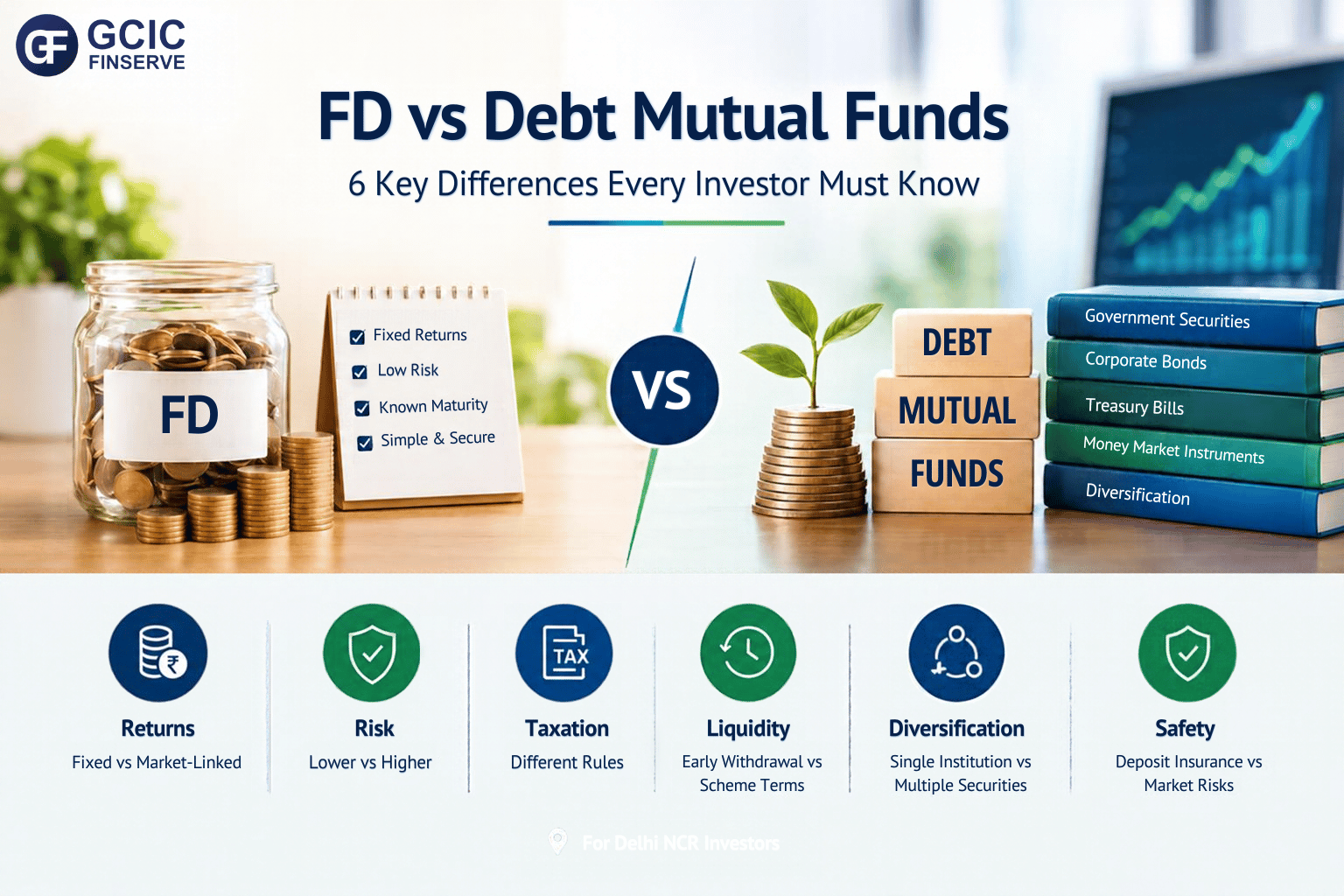
FD vs debt mutual funds is a common question for investors who want to manage their money without taking direct exposure to the stock market. Both options can play a role in the conservative part of a portfolio, but they work differently.
A fixed deposit (FD) offers a contracted interest rate for a chosen tenure, subject to the institution’s terms. A debt mutual fund invests in fixed-income securities, and its returns depend on the income and market value of those investments.
So, which option is right for you? The answer depends on your financial goals, investment horizon, liquidity needs, risk tolerance and tax situation.
Table of Contents
What Is a Fixed Deposit?
What Is a Debt Mutual Fund?
FD vs Debt Mutual Funds: 6 Key Differences
Can You Lose Money in a Debt Mutual Fund?
Taxation, Liquidity and Safety
Which Option May Suit Your Needs?
Frequently Asked Questions
1. What Is a Fixed Deposit?
A fixed deposit is an investment in which you deposit money with a bank or eligible financial institution for a specified period at an agreed interest rate.
For example, if you invest ₹10 lakh in an FD at an illustrative interest rate of 7% per annum for three years, the applicable interest and maturity amount can generally be calculated in advance, subject to the FD’s terms and compounding method.
This predictability makes FDs useful for people who prefer knowing their expected returns.
However, premature withdrawal may result in a penalty or reduced interest. Also, the safety of an FD depends on the institution and applicable protections.
Eligible bank deposits are insured by the Deposit Insurance and Credit Guarantee Corporation (DICGC) up to ₹5 lakh per depositor per bank, including principal and interest, subject to applicable rules.
A debt mutual fund pools money from investors and invests it in fixed-income instruments such as government securities, corporate bonds, treasury bills, certificates of deposit and money-market instruments.
Unlike an FD, a debt mutual fund does not offer a guaranteed rate of return or promise that your invested capital will remain unchanged.
Different categories of debt funds have different risk profiles. For example, liquid funds generally invest in short-term instruments, while longer-duration funds may be more sensitive to changes in interest rates.
Before investing, understand the scheme’s portfolio, investment strategy, credit quality, duration and associated risks.
3. FD vs Debt Mutual Funds: 6 Key Differences
The following comparison explains how these two investment options differ.
Factor
Fixed Deposit
Debt Mutual Fund
Returns
Contracted interest rate for the tenure
Market-linked returns; not guaranteed
Capital value
Generally predictable under the deposit terms
NAV can rise or fall
Risk
Institution and deposit-related risks
Interest-rate, credit and liquidity risks
Liquidity
Premature withdrawal may have conditions or penalties
Redemption subject to scheme terms and applicable timelines
Taxation
Interest generally taxable according to applicable rules
Tax depends on fund classification, acquisition date and applicable tax law
Diversification
Exposure to the depositing institution
Can spread investments across multiple securities and issuers
Neither option is automatically better for every investor. The right choice depends on what you expect the money to achieve.
4. Returns: Fixed Interest vs Market-Linked Performance
One of the main differences in FD vs debt mutual funds is how returns are determined.
With an FD, the applicable interest rate is generally agreed upon when you make the deposit. This makes it easier to estimate the maturity amount.
Debt mutual fund returns are different. They depend on interest income from the underlying securities, changes in their market prices, expenses and other portfolio factors.
For example, when market interest rates fall, existing fixed-rate bonds may become more valuable, potentially increasing a debt fund’s NAV. When interest rates rise, bond prices may fall, reducing the NAV.
Therefore, debt mutual funds can deliver positive or negative returns over a particular period. Higher returns are never guaranteed.
5. Can You Lose Money in a Debt Mutual Fund?
Yes. Debt mutual funds are not risk-free, and their NAV can decline.
Three important risks to understand are:
Interest-rate risk: Bond prices generally fall when market interest rates rise, all else being equal.
Credit risk: A bond issuer may experience financial difficulties or fail to meet its payment obligations.
Liquidity risk: Some securities may be difficult to sell quickly at a reasonable price, especially during stressed market conditions.
These risks vary between schemes. A liquid fund, a short-duration fund and a credit-risk-oriented fund may have very different portfolios and risk characteristics.
Read the scheme’s current Scheme Information Document (SID), portfolio disclosures and risk information before investing.
For more information, visit AMFI India, the Association of Mutual Funds in India.
6. Taxation, Liquidity and Safety
Taxation
FD interest is generally taxable according to the applicable income-tax rules. Tax deducted at source (TDS) may apply where relevant.
Debt mutual fund taxation depends on factors such as the fund’s classification, the date of acquisition and the prevailing tax provisions. Do not assume that debt mutual funds automatically provide a tax advantage over FDs.
FDs may allow premature withdrawal, but the applicable conditions, penalties and interest adjustments depend on the institution and deposit terms.
Debt mutual funds generally allow redemptions according to the scheme’s terms. However, exit loads, applicable settlement timelines and restrictions may apply to certain schemes.
Remember that the ability to redeem an investment does not guarantee that you will receive your original invested amount.
Safety
An FD offers greater predictability regarding its contracted interest rate and maturity terms, but it is not automatically risk-free. Deposit insurance applies only within the applicable eligibility and coverage limits.
A debt mutual fund carries market and portfolio risks, and its NAV can fluctuate.
Before choosing either option, assess the risks you can reasonably accept and when you will need the money.
Diversification: An Important Advantage of Debt Mutual Funds
Diversification is another consideration when comparing FDs and debt mutual funds.
If you place your money in one FD, your deposit exposure is concentrated in that institution. A debt mutual fund may invest across several securities, issuers and maturity profiles.
This can help diversify certain risks, but it does not eliminate the possibility of losses. A fund may still be affected by interest-rate movements, credit events or liquidity problems.
Diversification should therefore be considered alongside portfolio quality, investment costs and the scheme’s objectives.
Which Option May Suit Your Needs?
Your investment decision should begin with the purpose of the money.
An FD may be worth considering if:
You prefer a known interest rate for a specified tenure.
You want to plan for a future expense with predictable maturity terms.
You prefer a straightforward deposit product.
You understand the withdrawal conditions and institution-related risks.
A debt mutual fund may be worth considering if:
You want exposure to a diversified portfolio of debt securities.
You understand that NAV can fluctuate.
You want to explore different debt fund categories and maturity profiles.
You can select a scheme whose risk characteristics match your investment horizon and objectives.
Before investing in a debt mutual fund, review its credit quality, portfolio concentration, duration, expense ratio and exit load. Do not select a long-duration fund simply because you want to park money for a few weeks or months.
Neither option is suitable for every financial goal, and your overall asset allocation also matters.
FD vs Debt Mutual Funds: Frequently Asked Questions
1. Is a debt mutual fund the same as an FD?
No. An FD is a deposit with an agreed interest rate and tenure, while a debt mutual fund invests in a portfolio of fixed-income securities. Its NAV can fluctuate.
2. Are debt mutual funds risk-free?
No. Debt mutual funds carry interest-rate, credit and liquidity risks. The extent of these risks depends on the scheme’s investments and strategy.
3. Can debt mutual funds give higher returns than FDs?
They can outperform FDs over some periods, but this is not guaranteed. Debt fund returns are market-linked, and investors may experience losses.
4. Which is safer: an FD or a debt mutual fund?
They involve different risks. An FD offers greater predictability of contracted interest and maturity terms, while a debt mutual fund has market-linked NAV and portfolio risks. Eligible bank deposits also have limited DICGC insurance protection, subject to applicable rules.
5. Should I move all my FDs into debt mutual funds?
Not necessarily. Consider your financial goals, investment horizon, liquidity requirements, risk tolerance, tax position and existing investments before making any changes.
6. Which option is better for short-term savings?
The answer depends on when you need the money, how much certainty you require and the risks you can accept. Compare the specific FD terms and the characteristics of any debt fund under consideration rather than assuming that one option is always better.
GCIC Finserve’s Perspective for Delhi NCR Investors
For investors in South Delhi and across Delhi NCR, choosing between an FD and a debt mutual fund should begin with a clear understanding of financial goals, liquidity needs and risk tolerance.
At GCIC Finserve, an AMFI-registered Mutual Fund Distributor (ARN-272705), we focus on helping investors understand mutual fund options and how they may fit into their broader financial plans.
If you need help understanding mutual fund categories and their associated risks, connect with GCIC Finserve to learn more.
Final Word
FD vs debt mutual funds is not about finding one universal winner. It is about matching an investment to the purpose of your money.
An FD offers a contracted interest rate and predictable maturity terms, subject to its conditions. A debt mutual fund provides exposure to a portfolio of debt securities, with market-linked returns and the possibility of NAV fluctuations.
Before investing, ask yourself three questions: When will I need the money? How much uncertainty can I accept? And how does this investment fit into my overall financial plan?
Make the objective clear first, and then evaluate the product.
Disclaimer: This article is for educational and informational purposes only and does not constitute investment, tax, legal or financial advice. Mutual fund investments are subject to market risks, including possible loss of principal. Returns are not guaranteed, and past performance does not assure future results. Fixed deposits are subject to the terms of the respective institution and applicable regulations; deposit insurance is subject to eligibility and prescribed limits. Tax laws may change. Please assess your financial goals and risk profile and consult an appropriately qualified professional before making investment decisions.
A simple visual guide to understanding bond prices and yields.
Understanding bond prices and yields can feel complicated when you first see a bond listing with terms such as 8% coupon, 7.5% yield, ₹1,000 face value, 2031 maturity, or a market price of ₹980 or ₹1,020.
But the basic idea is simple.
A bond is essentially a loan. You lend money to a government, company, or other issuer, and in return, the issuer promises to pay interest and repay the principal according to the terms of the bond.
To understand most bond listings, you need to know five basic terms:
Face value, coupon, price, yield, and maturity.
Once these concepts become clear, understanding bond prices and yields becomes much easier.
A Simple Example: Lending ₹1,000
Imagine a company issues a bond with a face value of ₹1,000.
It promises to pay you 8% interest every year and repay the ₹1,000 principal after five years, subject to the issuer meeting its obligations.
In simple terms:
You invest: ₹1,000
Annual coupon: 8%
Annual interest: ₹80
Maturity: 5 years
Principal repayment: ₹1,000 at maturity, subject to the issuer’s obligations
This is the basic structure of a bond.
However, there is an important difference between bonds and fixed deposits: bonds can trade in the market, so their market price can move above or below their face value.
That’s where understanding bond prices and yields becomes important.
What Is Face Value?
Face value is the amount stated on the bond.
For example, if a bond has a face value of ₹1,000, that is the reference amount used to calculate its coupon payments. Subject to the bond’s terms and the issuer meeting its obligations, the face value is normally the amount repaid when the bond matures.
However, the face value is not necessarily the price you pay.
A ₹1,000 face-value bond could trade at:
₹950
₹1,000
₹1,050
The face value remains ₹1,000, while the market price changes based on factors such as interest rates, demand, credit risk and liquidity.
What Is a Coupon?
The coupon is the interest rate specified by the bond.
Suppose a bond has:
Face value: ₹1,000
Coupon rate: 8%
The annual coupon payment would generally be:
₹1,000 × 8% = ₹80
An important point is that the coupon is calculated on the face value, not necessarily on the price you paid.
For example, if you purchase the same bond for ₹950, you would still generally receive ₹80 in annual coupon payments, subject to the bond’s terms.
If you purchase it for ₹1,050, the coupon would still generally be ₹80.
So why does the market price matter?
Because your purchase price affects the yield you receive relative to your investment.
Understanding Bond Prices and Yields: Why Do Bond Prices Move?
This is one of the most important concepts for bond investors.
Bond prices and market interest rates generally move in opposite directions.
When interest rates rise
Suppose your existing bond pays an 8% coupon.
Now imagine new bonds with similar risk start offering higher rates.
Your existing 8% bond becomes relatively less attractive. Its market price may therefore fall so that its effective yield becomes more competitive.
When interest rates fall
Now imagine new bonds with similar risk offer lower rates.
Your existing 8% bond may become more attractive because it offers a higher fixed coupon than newly issued bonds.
Its market price may therefore rise.
The simple rule
When market interest rates rise, existing bond prices generally fall.
When market interest rates fall, existing bond prices generally rise.
This relationship is central to understanding bond prices and yields.
The actual price movement depends on several factors, including the bond’s maturity, duration, credit quality, liquidity, and prevailing market conditions.
What Is Yield and Yield to Maturity?
The coupon rate and yield are not necessarily the same thing.
Suppose our ₹1,000 face-value bond pays ₹80 per year.
If you buy it for ₹950, your simple current yield based on the annual coupon would be:
₹80 ÷ ₹950 × 100 = 8.42%
If you buy the same bond for ₹1,050:
₹80 ÷ ₹1,050 × 100 = 7.62%
So, although the coupon remains 8%, the yield based on your purchase price changes.
What Is Yield to Maturity?
Yield to Maturity (YTM) is a more comprehensive measure.
It estimates the annualised return you may earn if you purchase the bond at its current market price and hold it until maturity, taking into account:
Coupon payments
Purchase price
Time remaining until maturity
Amount expected to be repaid at maturity
For example, buying a bond below its face value may result in both coupon income and a potential gain if the bond is repaid at face value at maturity, assuming the issuer meets its obligations.
This is why YTM can be more useful than coupon rate alone when comparing bonds.
However, YTM is based on assumptions and does not eliminate credit, liquidity, interest-rate, or reinvestment risks.
Credit Risk, Maturity, and Duration
A bond is still a form of lending, so it carries risk.
Credit Risk
Credit risk is the possibility that the issuer may not make interest or principal payments as promised.
Credit ratings such as AAA, AA, and other ratings can provide information about an issuer’s creditworthiness, but a rating is not a guarantee of repayment.
A bond offering a higher yield is therefore not automatically better.
A higher yield may reflect higher perceived risk, lower liquidity, or other characteristics of the bond.
Maturity
Maturity is the date when the bond’s principal is scheduled to be repaid, subject to the bond’s terms and the issuer meeting its obligations.
A bond maturing in 2031, for example, has a scheduled maturity date in 2031.
Generally, the longer you remain invested, the longer your money may be exposed to changes in interest rates and other market conditions.
Duration
Duration is a measure of a bond’s sensitivity to changes in interest rates.
In general, bonds with higher duration tend to experience larger price movements when interest rates change.
This is why two bonds with similar coupons can behave very differently when market interest rates move.
Bonds vs Fixed Deposits
Bonds and fixed deposits may appear similar because both can provide interest income, but they work differently.
Feature
Bonds
Fixed Deposits
Nature
Market-linked debt security
Deposit with a bank/financial institution
Interest
Coupon as specified by the bond
Rate fixed according to FD terms
Market price
Can rise or fall
Usually no market price fluctuation like a traded bond
Early exit
May involve selling in the market
Premature withdrawal depends on the institution’s terms
Credit risk
Depends on the issuer
Depends on the deposit-taking institution and applicable protection/framework
Liquidity
Depends on market demand
Depends on the FD’s terms and premature-withdrawal facility
Return consideration
Coupon, purchase price and potential price movement matter
Interest rate and applicable terms matter
Neither is automatically better.
The right choice depends on factors such as your financial goals, investment horizon, liquidity needs, risk tolerance and overall portfolio.
What to Check Before Buying a Bond
Don’t look only at the headline coupon rate.
Before considering a bond, review:
1. Issuer
Understand who is borrowing your money.
Look at the issuer’s financial position, business profile and available disclosures.
2. Credit Rating
Check the bond’s credit rating and understand what it indicates about credit risk.
Remember that ratings are opinions about creditworthiness, not guarantees.
3. Coupon
Understand how much interest the bond is scheduled to pay and how frequently payments are made.
4. Market Price
Check the actual price at which you would be purchasing the bond.
A bond with a high coupon may not necessarily provide a high effective return if it is trading at a significant premium.
5. Yield or YTM
Compare the yield or YTM rather than looking only at the coupon rate.
6. Maturity
Check how long your money may remain invested and when principal is scheduled to be repaid.
7. Liquidity
Check how actively the bond trades.
A bond may be difficult to sell quickly at a desirable price if there is limited market liquidity.
8. Risks and Terms
Read the bond’s documentation carefully, including applicable risks, payment terms, security, covenants and other conditions.
For official information on government securities and retail participation, investors can refer toRBI Retail Direct.
Understanding Bonds with GCIC Finserve
AtGCIC Finserve, we believe investment decisions should begin with understanding the product, its risks, and how it fits into your overall financial goals.
For Delhi NCR investors, understanding the differences between bonds, fixed deposits, mutual funds, and other investment products can help create a more informed approach to financial planning.
If you want to understand how different investment options may fit your financial objectives and risk profile,connect with GCIC Finserve to discuss your requirements.
Frequently Asked Questions
Q1. Is an 8% coupon the same as an 8% return?
No.
An 8% coupon generally means the bond pays 8% of its face value as interest, subject to the bond’s terms. Your actual return can differ depending on the price you paid, coupon payments, holding period and the amount received at maturity or sale.
Q2. Why can a ₹1,000 bond trade at ₹950?
Because bonds trade in the market.
Changes in interest rates, demand and supply, credit risk, liquidity and other market factors can cause a bond’s market price to move above or below its ₹1,000 face value.
Q3. Why do bond prices fall when interest rates rise?
When new bonds offer higher interest rates, older bonds with lower fixed coupons may become less attractive.
Their market prices may therefore fall to make their effective yields more competitive.
Q4. Is a higher bond yield always better?
No.
A higher yield may come with higher credit risk, interest-rate risk, liquidity risk, or other risks.
Investors should consider risk and return together, rather than choosing a bond only because its yield is higher.
Q5. Can I lose money in a bond?
Yes.
You may experience a loss if you sell the bond at a lower market price than your purchase price.
There is also the possibility of loss if the issuer fails to meet its payment obligations.
Therefore, bonds should not automatically be considered risk-free investments.
Q6. What is the difference between a coupon and YTM?
The coupon is the interest rate specified by the bond and is generally calculated on its face value.
YTM estimates the annualised return based on the bond’s current purchase price, coupon payments, time to maturity, and repayment amount at maturity, subject to its assumptions.
Q7. Are bonds suitable for every investor?
Not necessarily.
The suitability of a bond depends on factors such as your financial goals, investment horizon, liquidity requirements, and risk profile.
It is important to understand the specific bond and its risks before investing.
Final Word
Understanding bond prices and yields becomes much easier once you remember five basic concepts:
Face Value — the amount stated on the bond
Coupon — the interest specified by the bond
Price — what you actually pay or receive when trading the bond
Yield — the return implied by the price and cash flows
Maturity — when the principal is scheduled to be repaid
The most important relationship to remember is:
Interest rates rise → existing bond prices generally fall
Interest rates fall → existing bond prices generally rise
Once you understand this relationship, along with credit risk, maturity, duration, and YTM, bond listings become much easier to evaluate.
The goal should not be to simply find the bond offering the highest rate. Instead, consider return, risk, liquidity, maturity, and how the investment fits into your overall financial plan.
Disclaimer: This article is for educational and informational purposes only and should not be considered investment advice or a recommendation to buy or sell any bond or financial product. Bond investments are subject to interest-rate risk, credit risk, liquidity risk and other applicable risks. Yields and returns are based on assumptions and may not represent actual realized returns. Investors should review the specific terms, issuer, credit rating, and risks of any investment before investing and consult a qualified financial professional where appropriate.
Understanding Indian market valuations, investment risks and long-term financial planning.
Are Indian markets too expensive right now? It is a question many investors ask when stock-market valuations appear high or the Nifty 50 is trading near elevated levels.
The concern is understandable. Nobody wants to invest a large amount just before a major market correction. At the same time, waiting indefinitely for markets to become “cheap” can also create its own challenges.
The more useful question is not simply whether Indian markets look expensive. It is whether current valuations are supported by earnings, business growth, economic conditions and your own investment horizon.
For investors in Delhi NCR and elsewhere, understanding this difference can help bring more perspective to market decisions.
What Does “Expensive” Mean in the Stock Market?
When investors describe a market as expensive, they are generally talking about valuation.
One commonly used measure is the Price-to-Earnings (P/E) ratio. It compares a company’s share price with its earnings per share.
For example, if a company earns ₹10 per share and its share price is ₹200, its P/E ratio is 20.
But valuation should not be viewed in isolation.
A company or market trading at a higher valuation may still have the potential to grow its earnings over time. Similarly, a low valuation does not automatically mean that an investment is attractive.
Therefore, when asking, “Are Indian markets too expensive right now?” investors should look beyond a single valuation number and consider earnings growth, economic conditions, business fundamentals, and their own financial objectives.
There is no single valuation measure that can conclusively tell investors whether the entire Indian market is “too expensive.”
Indian equities can trade at valuations above or below their historical averages at different points in the market cycle. Valuations can also differ significantly between sectors and individual companies.
For this reason, describing the entire market as either “cheap” or “expensive” can oversimplify a much more complicated situation.
A better approach is to consider questions such as:
Are corporate earnings growing?
Are current valuations supported by business fundamentals?
What are the broader economic conditions?
How much volatility can you tolerate?
When will you actually need the invested money?
Market valuation is therefore one factor to consider, not a standalone investment decision.
For official market information, investors can refer to NSE India and its publicly available market and research resources.
2. Why Waiting for a Correction Can Be Difficult
Suppose you believe the market is expensive and decide to wait for a correction.
The market may fall eventually. But it may also remain elevated or move higher before any meaningful correction occurs.
This creates a common dilemma.
If markets rise while you remain on the sidelines, you may later feel pressure to invest at an even higher level. If markets fall sharply after you invest, you may question whether waiting would have been better.
The important point is that short-term market movements are difficult to predict consistently.
Even when valuations appear stretched, investors cannot know exactly when a correction will occur or how deep it will be.
That is why investment decisions are generally better considered in the context of financial goals, time horizon, and risk tolerance rather than a single prediction about the next market move.
3. Can a Market Grow Into Its Valuation?
Yes, this can happen.
Consider a simplified example.
A company earns ₹10 per share and trades at ₹200, giving it a P/E of 20.
If the company’s earnings increase to ₹15 per share while its share price remains at ₹200, its P/E would fall to approximately 13.3.
The share price did not fall. Instead, the underlying earnings increased.
Real markets are much more complex because prices reflect expectations about future earnings, interest rates, economic conditions, and investor sentiment.
Nevertheless, the example demonstrates an important point:
Today’s valuation does not by itself determine tomorrow’s market return.
A market that appears expensive today can become more reasonably valued if earnings grow. Equally, valuations can remain elevated or become more stretched if investor expectations rise faster than underlying earnings.
4. What Should Long-Term Investors Focus On?
A short-term market participant may ask:
“What will the market do next?”
A long-term investor may need to ask a different question:
“What am I investing for, and how long can I remain invested?”
Equity markets can experience substantial declines over shorter periods. Investors may therefore experience periods of volatility, sometimes lasting for extended periods.
This is why an investment horizon matters.
Money required for a near-term financial commitment may need to be treated differently from money being invested for a long-term goal.
Instead of trying to predict every market high and low, long-term investors can focus on:
Financial goals
Investment horizon
Risk tolerance
Asset allocation
Diversification
Portfolio suitability
Ability to remain invested during market volatility
Historical market performance can provide context, but it does not guarantee future returns.
If you are reviewing your existing investment approach, you can also explore GCIC’s financial assessment to understand the broader factors that may need to be considered.
5. How Regular Investing Can Help Manage Timing Risk
Regular investing can be one way of reducing the pressure associated with trying to identify the “perfect” entry point.
When markets are higher, a fixed investment amount buys fewer units. When prices are lower, the same amount can buy more units.
This does not remove market risk and does not guarantee profits.
However, for investors whose financial goals and risk profile are suitable for regular investing, investing systematically can reduce dependence on making a single large timing decision.
The appropriate approach can vary from one investor to another, particularly when dealing with a significant lump sum.
For general investor education and mutual fund-related information, investors can also refer to AMFI.
What Should You Consider When Markets Look Expensive?
There is no universal answer.
If You Are Already Invested
A higher market valuation by itself may not necessarily mean that an investor should make a wholesale change to their portfolio.
It may be more useful to review whether the existing asset allocation remains aligned with the investor’s financial goals, investment horizon and risk profile.
If You Invest Regularly
Market valuations can be one factor to monitor, but stopping a long-term investment plan solely because markets appear expensive may not be appropriate for every investor.
The decision should be considered in the context of the investor’s objectives and overall financial plan.
If You Have a Large Lump Sum
Investing a large amount at one point exposes the investor to the market conditions prevailing at that time.
Depending on the investor’s circumstances, financial objectives, and risk profile, a phased approach may be considered instead of making a decision based entirely on a market-level valuation.
This is not a universal recommendation. The appropriate approach depends on individual circumstances.
If You Need the Money Soon
This may be the most important question.
If money is required for a near-term financial goal, the discussion should not be limited to whether Indian markets are expensive.
The more fundamental question is whether equity-market exposure is suitable for that particular goal and time horizon.
GCIC Finserve’s Perspective for Delhi NCR Investors
At GCIC Finserve Limited, we believe market valuation should be considered as part of a broader investment discussion rather than treated as the only factor.
For investors in Delhi NCR, investment decisions can be evaluated around financial goals, time horizon, risk profile, asset allocation, and the ability to remain invested through different market conditions.
As an AMFI-registered Mutual Fund Distributor (ARN-272705), GCIC Finserve Limited provides mutual fund distribution services. Investors should evaluate the suitability of any investment based on their own circumstances and available product information.
You can contact GCIC Finserve to learn more about the services available and discuss your financial requirements.
For official market information, investors can refer to NSE India. For general mutual fund investor information, AMFI is another useful official industry resource.
FAQ
1. Are Indian markets too expensive right now?
Indian market valuations can appear elevated when compared with certain historical measures, but there is no single valuation metric that can conclusively determine whether the entire market is “too expensive.” Valuation should be considered alongside earnings, economic conditions, investment horizon and risk.
2. Should I stop my SIP because the market looks expensive?
Valuation alone may not be sufficient to decide whether to stop a long-term investment plan. Financial goals, investment horizon, risk tolerance and overall asset allocation should also be considered.
3. Is it better to wait for a market correction before investing?
A correction may provide lower prices, but there is no reliable way to know when a correction will occur, how large it will be or how long an investor may need to wait. Investment decisions should therefore not depend solely on predicting the next market correction.
4. Can expensive markets become reasonably valued without falling?
Yes. If corporate earnings grow while market prices remain relatively stable, valuation multiples can decline over time. However, future earnings growth is uncertain and should not be treated as a guaranteed outcome.
5. Do Indian markets always go up in the long run?
No. Equity markets can experience significant declines and prolonged periods of volatility. Historical performance should not be interpreted as a guarantee of future returns.
Final Word
Are Indian markets too expensive right now?
The honest answer is that valuation levels deserve attention, but the word “expensive” does not automatically mean “do not invest.”
For a long-term investor, the more useful questions are:
What is the goal?
How long can the money remain invested?
What level of risk can be accepted?
Is the portfolio appropriately diversified and aligned with the investor’s circumstances?
Market cycles will continue to change. Instead of attempting to predict every market high and low, investors can focus on the factors they can actually control: their goals, time horizon, risk tolerance and investment approach.
Disclaimer
This article is for educational purposes only and should not be considered investment advice or a recommendation. Past performance does not guarantee future returns. Investors should consider their financial goals, risk profile and investment horizon before investing. Mutual Fund investments are subject to market risks, read all scheme related documents carefully. GCIC Finserve Limited is an AMFI-registered Mutual Fund Distributor (ARN: 272705).
Understanding how dollar vs INR movements can affect investors, imports and international investments.
Dollar vs INR has been impossible to miss lately. The Indian rupee has been trading around the ₹96-per-dollar level, with the rupee ending at ₹96.3150 against the US dollar on October 1, 2026.
But beyond the headline number, what does a weaker rupee actually mean for a Delhi NCR household or investor?
The impact goes far beyond foreign travel or shopping on international websites. Currency movements can affect oil prices, imported goods, overseas education costs, businesses and even the rupee value of investments held abroad.
Let’s understand dollar vs INR in simple terms.
What Does ₹96 to a Dollar Actually Mean?
When people say the dollar is at ₹96, it simply means you need approximately ₹96 to buy US$1.
For example, if the exchange rate was ₹85 earlier and moves to ₹96, the rupee has weakened against the dollar because you now need more rupees to purchase the same one dollar.
If the rate moves from ₹96 to ₹90, the rupee has strengthened.
The number itself is not automatically good or bad. What matters is why the exchange rate moved and how that movement affects your income, expenses, investments and financial goals.
For someone living in South Delhi, Gurgaon/Gurugram, Noida or elsewhere in Delhi NCR, the effect could show up through imported products, fuel costs, overseas education expenses or international investments.
Why Does Dollar vs INR Keep Moving?
The dollar vs INR exchange rate is influenced by demand and supply in the foreign-exchange market.
Several factors can influence this movement.
Oil Prices
India relies heavily on imported crude oil, and international oil transactions are largely denominated in US dollars.
When crude oil prices rise while the rupee weakens, the rupee cost of India’s energy imports can increase. This can put additional pressure on the currency and potentially affect inflation and transportation costs.
Recent market pressure on the rupee has also been associated with higher oil prices, global bond yields and foreign portfolio outflows.
US Interest Rates and Global Yields
US interest rates and global bond yields can influence international capital flows.
When dollar-denominated assets become relatively more attractive, some investors may move money towards those assets. Such flows can affect currencies including the Indian rupee.
Foreign Investment Flows
Money moving into or out of Indian financial markets can also influence demand for rupees and dollars.
Foreign investors are one part of the market, but they are not the only factor.
Inflation and Economic Conditions
Inflation, economic growth, trade flows, interest-rate differences and broader global economic conditions can all influence exchange rates.
This is why dollar vs INR cannot be explained by a single factor.
For official information on India’s monetary and foreign-exchange framework, investors can refer to the Reserve Bank of India.
How Foreign Investors Affect the Rupee
Imagine a foreign investor wants to buy ₹100 crore worth of Indian shares.
The investor generally needs to convert foreign currency into rupees to make the investment. This creates demand for rupees.
If the investor later sells those investments and converts the proceeds back into dollars, the flow moves in the opposite direction.
However, foreign investors are only one part of the foreign-exchange market. Indian importers, exporters, banks, companies, financial institutions and the Reserve Bank of India also participate in or influence the broader currency market.
So, a change in dollar vs INR should not automatically be attributed to foreign investors alone.
Why Should You Actually Care About Dollar vs INR?
You don’t need to travel abroad or own US stocks for the exchange rate to matter.
Everyday Expenses
India imports several goods, raw materials and energy products.
When imported items become more expensive in rupee terms, businesses may eventually pass some of those higher costs to consumers.
This does not mean every imported product will immediately become more expensive. The actual impact depends on the product, business costs, competition and other economic conditions.
Overseas Education
Consider a student planning to study in the United States.
A US$50,000 course would cost approximately:
At ₹85/USD: ₹42.5 lakh
At ₹96/USD: ₹48 lakh
The university fee has not changed.
The difference of approximately ₹5.5 lakh comes entirely from the exchange rate.
This is why families planning overseas education should consider currency movements as part of their financial planning.
International Travel
Flights, accommodation, tuition fees and other overseas expenses are ultimately affected by the exchange rate when you pay in a foreign currency.
A weaker rupee can therefore increase the rupee cost of expenses that are directly linked to foreign currencies.
A Weak Rupee Isn’t Always Bad
A weaker rupee does not affect every business in the same way.
Companies that earn a significant portion of their revenue in foreign currencies may benefit when those earnings are converted into rupees.
For example, suppose an Indian company earns US$10 million from overseas operations.
At ₹85/USD, that revenue converts to approximately ₹85 crore.
At ₹96/USD, the same US$10 million converts to approximately ₹96 crore, before considering other factors such as hedging, costs, taxes and the company’s operating expenses.
On the other hand, companies that depend heavily on imported raw materials, machinery or other inputs may face higher costs when the rupee weakens.
Therefore, rupee depreciation can affect businesses differently, depending on their business model and currency exposure.
Investors should therefore look beyond the exchange-rate headline and understand how a company’s revenues, costs and foreign-currency exposure work.
Has the Rupee Always Been This Weak?
The rupee’s long-term movement against the dollar has not been a straight line, but the annual average exchange rate has generally moved higher over the years.
According to OECD data published through FRED, the approximate annual averages were:
Year
Average INR per USD
2021
₹73.92
2022
₹78.61
2023
₹82.60
2024
₹83.68
2025
₹87.16
These are annual averages, not end-of-year exchange rates. FRED identifies the underlying source as OECD’s Main Economic Indicators.
The rupee subsequently moved around the ₹96-per-dollar level in late September and early October 2026, with ₹96.3150 recorded on October 1, 2026.
The important point is that historical currency movement does not tell us where the exchange rate will go next.
Exchange rates are influenced by many domestic and global factors and can move in either direction.
For investors interested in checking historical USD/INR data, the FRED series provides publicly available historical exchange-rate information.
What Does Dollar vs INR Mean for Your Investments?
Currency movements can become particularly important when you invest internationally.
Suppose you invest US$10,000 when the exchange rate is ₹85/USD.
Your investment costs approximately:
₹8.5 lakh
Now suppose the underlying investment does not change in dollar terms, but the rupee weakens to ₹96/USD.
The same US$10,000 would then be worth approximately:
₹9.6 lakh
The ₹1.1 lakh difference comes from the currency movement rather than investment performance.
However, the opposite can also happen.
If the rupee strengthens, the rupee value of the same foreign investment can decrease even if the investment’s foreign-currency value remains unchanged.
This is known as currency risk.
Therefore, international investing involves considering two separate factors:
How the underlying investment performs.
How the rupee moves against the foreign currency.
Currency movements can also affect Indian companies.
For example, an IT company earning significant dollar revenue may experience a different impact from a weaker rupee than a company that imports large quantities of raw materials.
Investors should therefore consider currency exposure as one part of understanding an investment—not as a standalone signal to buy or sell.
You can also explore GCIC Finserve’s investment solutions to understand the range of investment products available through the platform.
Should You Buy Dollars Because the Rupee Is Falling?
Not necessarily.
Seeing dollar vs INR near ₹96 and assuming that it will reach ₹100 can encourage investors to make decisions based purely on expectations about future currency movements.
That is effectively a bet on the direction of the exchange rate.
A more useful question is:
Do you actually have a financial need for dollar exposure?
For example, dollar exposure may be relevant if you are planning:
Overseas education
International travel
Future expenses in foreign currency
Long-term international investments
Diversification across geographical markets
Buying dollars purely because the rupee has recently fallen is a different decision and involves currency-market risk.
Investment decisions should instead consider financial goals, time horizon, risk profile, liquidity requirements and overall asset allocation.
How Can Delhi NCR Investors Think About Currency Risk?
For investors in South Delhi, Gurgaon/Gurugram, Noida and Ghaziabad, currency movements can become relevant in different ways.
A family planning a child’s education abroad may have a direct future dollar requirement.
A professional investing internationally may have foreign-currency exposure through an investment.
An investor holding Indian companies with substantial export revenues may be indirectly exposed to currency movements through the company’s business operations.
The same exchange-rate movement can therefore affect different people differently.
Instead of reacting to a headline such as “Dollar reaches ₹96,” investors can ask:
Do I have future expenses in dollars?
Do my investments have international exposure?
Are any of my investments exposed to foreign revenues or imported costs?
Does my overall portfolio have an appropriate level of diversification?
Has my financial goal or investment horizon changed?
A broader financial review can help put the exchange-rate movement into context. GCIC Finserve’s Financial Assessment page provides information about financial assessment and investment planning.
GCIC Finserve’s Perspective for Delhi NCR Investors
At GCIC Finserve Limited, we believe investors should look at dollar vs INR as one part of a much larger financial picture.
Currency movements should be considered alongside inflation, interest rates, oil prices, foreign investment flows, investment objectives, liquidity requirements and personal financial goals.
As an AMFI-registered Mutual Fund Distributor (ARN-272705), GCIC Finserve focuses on helping investors understand available mutual fund options and associated risks.
The important distinction is that currency movement itself is not an investment signal.
For investors across Delhi NCR, the more useful question is:
“How could currency movements affect my own financial goals and investments?”
Understanding this can help investors focus on their financial objectives rather than reacting solely to short-term market headlines.
Frequently Asked Questions
Q1. Is ₹96 per dollar good or bad for India?
Neither in isolation. A weaker rupee can increase the rupee cost of imports while potentially benefiting some exporters and companies earning foreign-currency revenue. The overall economic impact depends on several factors.
Q2. Does a falling rupee mean the stock market will fall?
Not necessarily. Different companies can be affected differently by currency movements. Overall stock-market performance depends on many factors beyond the exchange rate.
Q3. Does a weaker rupee make my overseas investments more valuable?
It can increase their value when measured in rupees if the foreign investment itself remains unchanged. However, currency movements can work in either direction.
Q4. Should I invest in US stocks because the rupee is weakening?
Currency movement alone is not a sufficient reason to invest internationally. Investors should consider their financial goals, diversification requirements, risk profile, investment horizon and the risks of the specific investment.
Q5. Why does crude oil affect the dollar vs INR exchange rate?
India relies heavily on imported crude oil, and international oil transactions are largely denominated in US dollars. Higher oil prices can increase India’s dollar requirements, while a weaker rupee can make those imports more expensive in rupee terms.
Q6. Can the rupee strengthen again after falling?
Yes. Exchange rates can move in either direction and are influenced by domestic and global factors including oil prices, interest rates, capital flows, trade conditions and inflation. Past movement does not guarantee future direction.
Q7. Should I buy dollars as an investment?
Not automatically. Dollar exposure may have a legitimate purpose when linked to future foreign-currency expenses or an appropriate international allocation, but buying currency purely because its recent price has increased involves currency risk.
Final Word
The next time you see ₹96 to a dollar in the news, it is worth looking beyond the headline.
Dollar vs INR connects India’s economy with the rest of the world—from oil prices and imported goods to overseas education, international investments and the revenues of Indian companies.
You do not need to predict where the dollar will be next month.
What matters more is understanding why the exchange rate matters and where it may affect your own financial goals.
Understand your options. Know the risks. Make informed decisions.
Disclaimer
This article is intended solely for general investor awareness and educational purposes and should not be construed as investment advice, a recommendation, or a solicitation to buy or sell any security, mutual fund, investment product or currency. Mutual fund investments are subject to market risks, including the potential loss of capital, liquidity risk and market volatility. Please read all scheme-related documents and applicable product documents carefully before making an investment decision. Currency markets are influenced by several domestic and global factors and cannot be predicted with certainty. Investors should consider their financial objectives, risk profile, investment horizon and liquidity requirements before making investment decisions. This content should not be treated as tax, legal or regulatory advice. Where appropriate, consult a suitably qualified/registered professional.
GCIC Finserve Limited
AMFI-registered Mutual Fund Distributor (ARN-272705)
Investment products are subject to market risks. Please read all scheme-related documents and applicable product documents carefully before investing.
A wealth partner can help bring investments, goals, and financial decisions together.
Why do you need a wealth partner? It’s a question that rarely comes up when you’re just starting out—a few SIPs, a bank account, maybe an insurance policy, and time doing the rest of the work. But as income grows across Delhi NCR’s fast-moving professional and business circles, financial lives rarely stay that simple. Money starts sitting across different institutions—a business, property, insurance, and retirement assets—and the question quietly shifts from “where should I invest?” to “how should all of my wealth work together?”
What Does a Wealth Partner Actually Mean?
At its core, the idea behind why you need a wealth partner comes down to one distinction: managing investments versus managing wealth. An investment is one piece of your financial life; understanding how all those pieces fit together—liquidity, risk, goals, asset allocation—is the broader picture.
Choosing a mutual fund answers where to invest ₹10 lakh. A wider conversation also asks, how much of your total wealth should stay liquid? Are you overexposed to one asset class? How should the portfolio evolve as goals get closer?
Why Do You Need a Wealth Partner as Your Finances Grow?
India’s investment landscape has expanded dramatically, which is part of why the wealth-partner conversation matters more today. According toAMFI India, the mutual fund industry’s assets under management grew from ₹15.63 lakh crore in August 2016 to ₹87.08 lakh crore by August 2026, with folios crossing 28.35 crore.
Investors today can choose from mutual funds, PMS, AIFs, SIFs, bonds, FDs, REITs, and InvITs—more choice, but not necessarily easier decisions.
The real challenge isn’t accessing investments anymore; it’s deciding which ones actually deserve a place in your financial life.
From Products to a Portfolio
Consider someone holding ten different mutual funds. Each may look reasonable individually, but that alone doesn’t confirm the portfolio makes sense—there could be significant overlap, too much exposure to one segment, or insufficient liquidity.
This is exactly where the question of why you need a wealth partner starts to matter: someone who looks beyond individual products and asks what the portfolio as a whole is actually trying to achieve.
From Investments to Decisions
Markets rise and fall, interest rates shift, and personal circumstances change. The hard part usually isn’t knowing what happened—it’s deciding what to do about it.
Should you rebalance? Deploy a cash surplus now or gradually? Move money just because something else recently performed better?
A structured process around these decisions—rather than reacting to headlines—is one of the clearest reasons investors consider professional financial support as their financial life becomes more layered.
What Areas Does This Kind of Support Cover?
The exact scope varies, but typically spans portfolio planning, asset allocation, goal planning, portfolio reviews, identifying concentration or overlap, risk and liquidity management, and rebalancing.
As financial circumstances become more complex, family wealth and succession considerations may also become relevant. Tax, legal, and estate matters usually require separate specialist professionals—coordination across these areas can still be an important part of the broader financial picture.
6 Signs You Might Need a Wealth Partner
Your financial situation has become hard to track on your own—multiple institutions, products, or accounts.
Your investable surplus has grown significantly and now needs a clearer structure.
You have both business and personal wealth that rarely get looked at together.
You’re approaching a major goal—retirement, a child’s education, or a large purchase.
You’re unsure whether your portfolio is genuinely diversified or just spread across many products.
You find yourself making investment decisions reactively, based on headlines rather than a plan.
The real question isn’t “How much money do I have?”—it”‘s “How much financial complexity am I comfortable managing myself?”
You Don’t Need One Just Because You Have Money
This distinction matters.
If your finances are straightforward and you have the time, interest, and discipline to manage everything yourself, doing it independently can work perfectly well.
The need typically emerges from complexity, not net worth alone. Someone with modest wealth but several overlapping goals may value structured support more than someone financially sophisticated with a simple, well-understood portfolio.
GCIC Finserve’s Perspective for Delhi NCR Investors
AtGCIC Finserve, an AMFI-registered Mutual Fund Distributor (ARN-272705) and APMI-registered PMS Distributor (APRN-08140), we help Delhi NCR investors and families understand their mutual fund and PMS investment options and how these may fit within their broader financial goals and circumstances.
The appropriate approach depends on individual objectives, risk profile, investment horizon, and financial situation.
Connect with our team to discuss your investment requirements and available options.
FAQs
Q1. Is a wealth partner the same as a mutual fund distributor?
Not necessarily. A mutual fund distributor primarily facilitates and services mutual fund investments, while “wealth partner” is a broader term. The exact services and regulatory permissions depend on the specific entity and its registrations.
Q2. Is a wealth partner only for high-net-worth individuals?
No. The need depends more on the complexity of your finances than your net worth alone. Someone with modest wealth but several goals may value structured support just as much.
Q3. Does working with a wealth partner mean giving up control of my investments?
Not necessarily. The structure depends on the services involved. Investors can retain decision-making authority while using professional support for research, planning, and review.
Q4. Can a wealth partner guarantee better investment returns?
No. Returns can never be guaranteed. The value of professional support can lie in portfolio construction, risk management, goal alignment, and disciplined decision-making—not guaranteed return maximization.
Q5. When should I start thinking about this kind of support?
There’s no fixed number. A useful trigger is increasing complexity: more assets, more goals, or more decisions than you’re comfortable managing alone.
Final Word
Why do you need a wealth partner? Ultimately, it comes down to one shift: from making money work to making all of your money work together.
As your financial life across Delhi NCR grows—more assets, more goals, more decisions—the value isn’t necessarily in finding the next best investment alone, but in keeping every piece of your financial picture aligned with what you actually want it to achieve.
Disclaimer: This article is intended for educational and informational purposes only and should not be construed as investment advice, a recommendation, or a solicitation to invest in any particular financial product. Investment decisions should be based on individual financial circumstances, objectives, risk profile, and investment horizon. Past performance is not indicative of future results. Please independently evaluate products and, where appropriate, seek advice from suitably qualified and regulated professionals.
Gold’s strong rally brings both opportunities and risks for investors.
Is gold’s rally over? That’s the question on many investors’ minds after gold delivered one of its strongest runs in recent memory. In India, gold gained around 21% in 2024, while domestic gold prices rose roughly 75% in 2025.
By Q2 2026, gold prices had pulled back from their early-year highs but remained historically elevated, with India’s domestic gold price still around 59% higher than a year earlier.
After a run like that, the question isn’t simply “Why is gold rising?” anymore. The bigger question is whether the forces behind the rally can continue.
Why Gold Hasn’t Risen for Just One Reason
It’s tempting to explain gold’s rally with a single word—”uncertainty. “The real picture is more complicated.
Geopolitical uncertainty, investor demand for diversification, expectations around interest rates, movements in the US dollar, and continued central-bank buying have all influenced gold demand.
Gold also benefited from strong investment demand during 2025. The World Gold Council reported that global gold demand exceeded 5,000 tonnes in 2025 for the first time, while global investment demand reached 2,175 tonnes, an 84% increase from 2024.
So, gold didn’t rise because of one single factor. Several forces supported the rally at the same time.
What Is Gold Actually Used For?
Gold’s investment story gets most of the headlines, but investment isn’t its only role.
Gold is also widely used for jewellery, central bank reserves, and technology applications. In India, jewellery continues to be an important part of gold demand even though high prices have changed purchasing behaviour.
Globally, the 2025 gold market showed an interesting contrast. Investment demand increased strongly, while jewellery demand fell as prices moved higher. The World Gold Council reported that global jewellery consumption declined 18% in 2025, even though the value of jewellery demand increased by 18%.
That tells us something important: when gold becomes expensive, consumers may buy less gold by weight while still spending significant amounts of money on it.
India’s Gold Demand Is Adapting, Not Disappearing
India provides a good example of this behavior.
In Q2 2026, Indian gold demand fell to 131 tonnes, down 6% year-on-year. Jewellery demand fell 15% year-on-year to 75 tonnes. Yet the value of India’s gold demand reached a quarterly record of approximately ₹1.979 lakh crore, up 35% year-on-year.
In other words, Indians were buying less gold by weight but spending more because prices were much higher.
Consumers have also been adapting by choosing lighter jewellery, lower-carat products, and old-gold exchanges. The World Gold Council noted that these changes have helped consumers manage affordability while maintaining their connection with gold.
For Delhi NCR households, this distinction matters. A strong gold price does not necessarily mean demand disappears. Instead, the way people buy gold can change.
What About Gold Supply?
Gold supply is another important part of the story.
The global gold supply reached approximately 5,002 tonnes in 2025, up around 1% from 2024. Mine production increased modestly, while recycled gold supply rose around 3%.
In India, however, Q2 2026 supply fell to a six-year low. The World Gold Council noted that adequate domestic inventories and recycling helped meet market requirements, meaning the lower supply did not indicate that the world was simply “running out of gold.”
This is important because gold behaves differently from commodities that are consumed permanently. Much of the gold ever mined remains in circulation in some form and can potentially return to the market.
Reasons the Rally Could Continue—or Cool Down
There are genuine reasons why gold could remain supported.
Central-bank demand remains important. Central banks bought around 863 tonnes of gold in 2025, significantly above the 2010–2021 annual average of 473 tonnes. In Q2 2026 alone, central bank net purchases reached approximately 289 tonnes, although the first-half pace remained below recent years.
Investment demand is another important factor. The World Gold Council expects investment to remain the principal source of gold-demand growth through the second half of 2026, with Asian investment and OTC activity expected to contribute significantly.
At the same time, there are reasons for caution.
High gold prices are putting pressure on jewellery demand. In Q2 2026, global jewellery demand fell 17% year-on-year, while Indian jewellery demand fell 15%. Investment demand outside OTC markets also declined to 262 tonnes during the quarter, partly reflecting gold ETF outflows.
So the picture isn’t simply “gold will keep rising” or “gold is about to crash. “Both supporting and opposing forces are present.
So, Is Gold’s Rally Over?
Is gold’s rally over? There is no reliable way to know for certain.
The case for continued support includes central bank buying, investment demand, geopolitical uncertainty, and the possibility of changing interest-rate conditions.
The case for caution includes elevated prices, weaker jewellery volumes and periods of reduced investment demand.
The World Gold Council’s Q2 2026 outlook expects investment to remain an important driver during the second half of 2026, while central banks are expected to remain significant buyers. At the same time, high prices are expected to continue weighing on jewellery volumes.
That makes the current environment more nuanced than simply asking whether gold will go up or down next.
The Real Risk May Be FOMO
There’s a psychological trap hiding underneath a major rally.
Someone who bought gold several years ago may have seen a significant increase in value. Someone who didn’t buy may now feel that they have missed their opportunity.
That’s where FOMO—fear of missing out—can become dangerous.
The thought process can quickly become:
“Gold has already gone up so much. I should buy before it goes even higher.”
But past performance doesn’t tell you what will happen next.
The more useful question isn’t simply “Is gold a good investment?”
It’s:
“What role should gold play in my overall financial plan?”
For some investors, gold may have a role in diversification. For others, physical gold may primarily serve cultural, family or wealth-preservation purposes. The appropriate allocation depends on the individual’s goals, existing portfolio, risk profile, and investment horizon.
GCIC Finserve’s Perspective for Delhi NCR Investors
At GCIC Finserve, an AMFI-registered Mutual Fund Distributor (ARN-272705), we believe gold deserves to be understood rather than chased.
A decision to buy gold simply because it has recently delivered strong returns is very different from allocating to gold because it has a clearly defined role in your overall portfolio.
Before making a decision, investors should consider:
Their existing asset allocation
Financial goals
Investment horizon
Risk tolerance
Liquidity requirements
Existing exposure to gold
If you’re considering gold alongside mutual funds or other investments, understanding how each asset fits into the overall portfolio can be more useful than focusing only on recent returns.
There is no reliable way to know. Gold continues to have support from investment demand and central-bank buying, while high prices are putting pressure on jewellery demand and making investors more price-sensitive.
Q2. How much has gold risen in India recently?
Gold gained around 21% in India during 2024, while domestic gold prices rose roughly 75% in 2025. By Q2 2026, India’s domestic gold price remained approximately 59% higher than a year earlier, despite a moderation from early-2026 highs.
Q3. Is gold in short supply right now?
There is no simple global shortage story. The global gold supply reached around 5,002 tonnes in 2025, with mine production and recycling contributing to the supply. India’s Q2 2026 supply fell to a six-year low, but the World Gold Council noted that inventories and recycling provided a buffer.
Q4. Should I invest in gold after its recent rally?
There is no universal answer. The decision should depend on your financial goals, existing asset allocation, investment horizon, liquidity needs, and risk tolerance rather than gold’s recent performance alone.
Q5. Can gold prices fall after a major rally?
Yes. Gold prices can decline, sometimes sharply, even after a strong period of appreciation. Investors should therefore avoid assuming that past price increases guarantee future returns.
Final Word
Is gold’s rally over? That’s a question the market cannot answer with certainty in advance.
Gold still has structural support from investment demand and central-bank interest, but elevated prices are also changing consumer behavior and putting pressure on jewelry demand.
For investors, the more useful question may not be whether gold will rise next month or next year. It is whether gold has a clear and appropriate role in their overall financial plan.
After a major rally, avoiding FOMO can be just as important as understanding the reasons behind the rally.
Disclaimer
This article is for educational and informational purposes only and should not be construed as investment advice or a guarantee of returns. Gold prices can be volatile and may decline substantially. Mutual fund and other market-linked investments are subject to market risks. Investors should consider their financial objectives, risk profile, investment horizon and liquidity requirements before making investment decisions. Please read all relevant product and scheme-related documents carefully and consult a qualified financial professional where appropriate.
India’s monthly SIP contribution reached a record ₹32,297 crore in August 2026, according to AMFI data.
SIP investments in India hit a record high of ₹32,297 crore in August 2026—the highest monthly SIP contribution ever recorded by AMFI. Ten years earlier, in August 2016, that number was just ₹3,497 crore. That’s a more than nine-fold jump in a decade. But behind this headline number is a much more interesting story for Delhi NCR investors: how Indians are quietly changing the way they think about money and what the cost of waiting to invest actually looks like.
Just How Big Is India’s SIP Boom?
The scale becomes clear when you place the numbers side by side. Monthly SIP contributions rose from ₹3,497 crore in August 2016 to ₹32,297 crore in August 2026. Outstanding SIP accounts reached 10.75 crore, with 10.02 crore actually contributing that month, and SIP assets under management touched ₹18.62 lakh crore. AMFI also recorded 66.40 lakh new SIP registrations in August alone, against 53.82 lakh SIPs that were discontinued or completed—a net addition of roughly 12.58 lakh accounts in just one month. SIP investments in India hitting a record high comes as part of a much larger increase in SIP participation over the past decade.
The Bigger Mutual Fund Story Behind the Numbers
SIPs are just one part of a much larger transformation. India’s overall mutual fund industry AUM stood at ₹87.08 lakh crore at the end of August 2026, up roughly six-fold from ₹15.63 lakh crore in August 2016. Mutual fund folios have grown from 10.86 crore in August 2021 to 28.35 crore in August 2026—more than a two-and-a-half-fold increase in just five years, with roughly 21.62 crore of those folios in equity, hybrid, and solution-oriented schemes. For Delhi NCR households, this points to something bigger than a passing trend: organized, systematic investing is becoming the norm rather than the exception.
Why Has the SIP Become So Popular?
The appeal is part mathematics, part psychology. Ask someone to invest ₹12 lakh in one go, and it immediately raises hard questions—where will the money come from, is the market at the right level, and what if it falls right after? Ask instead, “Can you invest ₹10,000 a month?” and the decision suddenly feels manageable. According to AMFI, a SIP, is simply a method of investing a fixed amount periodically in a mutual fund scheme, helping investors stay disciplined without trying to time the market. It’s worth remembering: a SIP is a method of investing, not an investment product in itself—the underlying mutual fund is what actually carries the risk and return.
The Real FOMO Isn’t About Missing the Next Rally
The common fear is “the market went up; I should have invested earlier.” But that’s not the FOMO that matters most. Consider two people who both could have started investing ₹10,000 a month five years ago—one did, one kept waiting for the “right time.” Five years later, the person who started has something the other person can never buy back: five years of investment time. You can increase your SIP amount later, change your strategy later, or even recover from a bad investment choice later—but you cannot recover lost time.
What Does Starting Early Actually Do?
Here’s a simple illustration. Investing ₹10,000 every month for 20 years means a total contribution of ₹24 lakh, which at an illustrative 12% annualized return could grow to approximately ₹99 lakh. Wait five years, and investing the same ₹10,000 monthly for only 15 years brings the total contribution down to ₹18 lakh, with an illustrative corpus of around ₹50 lakh. (These are hypothetical illustrations, not guaranteed returns—actual outcomes depend on market performance, fund selection, costs, and taxes.) The investor who waited contributed just ₹6 lakh less, yet the eventual illustrative gap is far larger—because those extra five years of compounding matter more than the headline contribution amount.
The Other Side of the SIP Story
Record SIP contributions shouldn’t push anyone into investing blindly. When your colleague has an SIP, your friend has three mutual funds, and headlines talk about ₹32,297 crore flowing in every month, it’s easy to feel like you’re “behind”—but that’s FOMO, not a strategy. The fact that millions of Delhi NCR residents (and Indians nationwide) are investing through SIPs doesn’t tell you what to invest in, how much risk to take, or which mutual fund category actually suits your goal. It’s also worth remembering that an SIP doesn’t remove market risk—if you’re invested in equity mutual funds, your value can still fall when markets fall. A SIP simply means you keep investing on schedule; it doesn’t eliminate volatility.
3 Questions to Ask Before Starting a SIP
Before jumping in because “SIP investments in India hit a record high” made headlines, ask yourself:
What am I actually investing for? Retirement, a child’s education, or a future purchase can each call for a different approach.
How long can I realistically stay invested? Your time horizon should match the volatility you’re willing to sit through.
How much can I invest without disrupting my monthly budget? A sustainable SIP beats an aggressive one you can’t maintain past a few months.
GCIC Finserve’s Perspective for Delhi NCR Investors
AtGCIC Finserve, AMFI-registered Mutual Fund Distributor (ARN-272705), we see the SIP boom as a genuine shift in household financial behavior—but record flows should never replace a plan built around your own goals and risk profile. If you have a long-term goal and keep postponing simply because the timing never feels perfect, it’s worth understanding what that delay is actually costing you in lost compounding time.Connect with our team to understand which mutual fund categories might suit your goals. For the latest official SIP and mutual fund industry data, refer toAMFI India’s official reports.
FAQs
Q1. Are SIP investments in India really at a record high?
Yes—AMFI reported ₹32,297 crore in monthly SIP contributions in August 2026, the highest in its published series.
Q2. Does a record SIP contribution mean the stock market will rise?No. SIP flows reflect investor participation, not a reliable signal of future market direction.
Q3. Is it too late to start a SIP now that contributions are at record highs?
There’s no universal answer—it depends on your goals, horizon, and risk tolerance. But waiting indefinitely for a “perfect” entry point can mean losing valuable compounding time.
Q4. Does starting a SIP early guarantee higher returns?
No. Starting earlier gives your investment more time to potentially compound, but actual returns still depend on market performance and the underlying fund.
Final Word
SIP investments in India hitting a record high isn’t a signal to rush in—it’s a signal that Indian investors, including many across Delhi NCR, are increasingly treating investing as a recurring habit rather than a one-time event. You don’t need to feel FOMO because someone else started before you. But if investing genuinely fits your goals, understand what indefinite postponement is costing you. The market will offer many entry points over your lifetime—time is the one entry point you can’t revisit.
Disclaimer: Mutual fund investments are subject to market risks. Read all scheme-related documents carefully before investing. This article is for educational and informational purposes only and should not be construed as investment advice or a guarantee of returns. The illustrations used are hypothetical. Please assess your own financial circumstances and, where appropriate, consult a qualified financial professional before investing. Data source: Association of Mutual Funds in India (AMFI), August 2026.