
Selling during a market crash can feel like the safest decision in the moment. But when markets recover, investors who sold in panic can sometimes find themselves facing a different problem: how and when to get back in.
This is the story of Arjun, a fictional investor based on a situation many Delhi NCR investors can relate to. One five-minute decision during a period of market panic changed the way he approached his long-term investment journey.
The Setup: A Normal Long-Term Investment
In 2010, Arjun invested ₹25 lakh into a diversified equity portfolio with a simple goal: build wealth over the next 15–20 years and support his family’s future needs.
He wasn’t trading or looking for quick profits. For years, his plan worked reasonably well. His portfolio went through good years, bad years, and a few uncomfortable corrections.
Arjun understood that markets don’t move in a straight line, so he stayed invested. Then came a market fall that tested that confidence.
For investors who want to understand how different investment structures work, our guide on Mutual Funds vs PMS and AIFs explains the key differences between these options.
When ₹60 Lakh Started Looking Like ₹40 Lakh
At its peak, Arjun’s portfolio had grown to roughly ₹60 lakh.
Then the market entered a sharp decline. The value moved from ₹55 lakh to ₹48 lakh, then ₹42 lakh, and eventually ₹40 lakh.
Almost ₹20 lakh had disappeared from the portfolio value.
Arjun knew, in theory, that equity markets could fall. But watching his own money decline day after day felt very different from reading about market volatility in an article—the numbers started becoming emotional.
Market volatility is a normal part of investing, but the way an investor responds to it can have a major impact on their investment journey. SEBI’s investor-education material explains volatility risk and discusses diversification as one way investors can manage different investment risks. (SEBI Investor)
The Moment of Selling During a Market Crash
One evening, Arjun called his advisor and said,
“I don’t want to lose any more.”
He wasn’t asking what fund to buy next—he had already made up his mind.
Despite being reminded about his long-term goal, Arjun sold his remaining equity investments and moved ₹40 lakh into cash.
For the first time in weeks, he felt relieved.
At least, he thought, the portfolio couldn’t fall any further.
Selling during a market crash felt like the safest decision at that moment.
But the difficult part came later.
What Happened After He Sold
The market eventually stopped falling—and started recovering.
Arjun told himself he would invest again “when things became clearer.”
But clarity didn’t arrive on his preferred schedule.
The market recovered 10%, then another 10%. Arjun continued waiting for a clear signal that it was safe to return.
By the time the market looked comfortable again, prices had already moved significantly higher, and buying back in suddenly felt expensive.
So he waited for another correction—one that didn’t arrive when he expected it.
Months became years, and the investor who had successfully avoided the fall ended up missing a significant part of the recovery.
NISM investor-education material similarly highlights the role of disciplined investing, long-term planning, and avoiding emotion-driven decisions during market fluctuations. (NISM)
The Two Paths: Staying Invested vs Staying in Cash
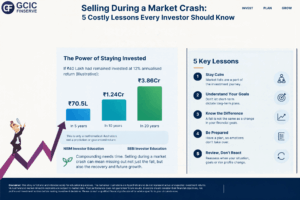
If Arjun’s ₹40 lakh had remained invested and earned an illustrative 12% annualized return, it could have grown to approximately ₹70.5 lakh in 5 years, ₹1.24 crore in 10 years, and ₹3.86 crore in 20 years.
(This is only a mathematical illustration, not a prediction or guaranteed return.)
Instead, if the ₹40 lakh simply remained as cash, it would still be approximately ₹40 lakh, ignoring interest, inflation, and taxes.
The important point is that compounding needs time—when an investor sells during a market crash, they may not just miss the fall, they can also miss the recovery and the future compounding that follows.
For more on how investment behavior can affect long-term outcomes, investors can also explore NISM’s educational material on disciplined investing and staying invested through market fluctuations. (NISM)
The Real Cost Wasn’t the Fall—It Was the Recovery He Missed
Consider an even simpler example.
Suppose an investor has ₹1 crore and the market falls by 30%.
The portfolio becomes ₹70 lakh.
To get from ₹70 lakh back to ₹1 crore, the portfolio needs to rise by approximately 42.9%, not 30%.
Now imagine the investor sells at ₹70 lakh.
If the market subsequently rises by 50%, the investor who stayed invested would have approximately ₹1.05 crore, while the investor who sold would still have ₹70 lakh if that money remained in cash.
This doesn’t mean investors should never sell—it simply shows why selling during a market crash can create another challenge: participating in the recovery.
Should You Never Sell?
Absolutely not—that would be the wrong lesson to take from this story.
There can be perfectly valid reasons to sell or reduce an investment: your financial goal has changed, your investment horizon has become shorter, your risk tolerance has changed, your circumstances are different, or the underlying investment case no longer fits your original plan.
These situations deserve a proper review.
The bigger concern is selling purely because the market is falling, without anything about your actual plan having changed.
Before selling during a market crash, ask yourself:
“If the market hadn’t fallen, would I still believe this portfolio is right for my long-term goal?”
If the answer is yes, your goal hasn’t changed—only the market value has.
That distinction can be important.
If you’re reviewing your mutual fund portfolio, you may also find our guide on Why Is My Mutual Fund Underperforming? useful for understanding whether underperformance is temporary or something that requires a deeper review.
GCIC Finserve’s Take
Arjun’s story is fictional, but the behavior behind it is something many Delhi NCR investors can relate to during difficult market cycles.
At GCIC Finserve, AMFI-registered Mutual Fund Distributor (ARN-272705), we believe investment decisions should be reviewed in the context of your financial goals, risk profile, investment horizon, and underlying investments—not simply because markets have temporarily fallen.
A market correction can be uncomfortable, but making a long-term decision during a short-term period of fear can have consequences.
Before selling during a market crash, take a step back and review whether your original plan has actually changed.
Investors can also refer to NISM’s investor-education resources for information on disciplined investing, financial planning, and understanding market fluctuations. NISM’s recent investor-education material specifically highlights disciplined investing and avoiding emotional decision-making during market cycles. (NISM)
For additional information about mutual fund risks, investors can refer to AMFI’s investor education resources. AMFI notes that mutual fund investments are subject to market-related risks and that returns are not guaranteed. (AMFI India)
If you’re unsure whether your portfolio still fits your goals, connect with GCIC Finserve or consider discussing your situation with a qualified financial professional before making a major investment decision.
FAQs
Q1. Is selling during a market crash ever a good idea?
It can be appropriate when your financial goals, investment horizon, risk tolerance, or the underlying investment have genuinely changed.
Selling purely because of short-term market fear, however, can make it difficult to participate in a subsequent recovery.
Q2. How much does a portfolio need to recover after a 30% fall?
A portfolio that falls 30% needs approximately a 42.9% gain to return to its original value.
Q3. Why do investors often miss the recovery after selling?
Markets don’t usually provide a clear signal telling investors exactly when the recovery has begun.
Investors waiting for “confirmation” may re-enter only after prices have already moved higher.
Q4. What should I ask myself before selling during a market crash?
Ask whether your original investment goal, time horizon, and reason for investing have changed.
If they haven’t, consider whether the decision is being driven mainly by short-term market fear.
Q5. Should I stop investing when the market falls?
There is no single answer for every investor.
The appropriate approach depends on your goals, risk profile, time horizon, and financial circumstances.
A market fall by itself does not automatically mean an existing investment plan is no longer suitable.
Final Word
A market fall is an event. Your response to it is a decision—and the two don’t necessarily have to be treated as the same thing.
Arjun didn’t need to predict the market bottom or buy at the lowest possible price.
He simply needed to understand the difference between a temporary market decline and a genuine change in his plan.
Sometimes, the biggest cost of selling during a market crash isn’t the loss you lock in—it’s the recovery and future compounding you may miss.
Disclaimer: This story is fictional and intended solely for educational purposes. The numerical illustrations are hypothetical and do not represent actual or expected investment returns. Mutual fund and market-linked investments are subject to market risks. Past performance does not guarantee future results. Investors should consider their financial objectives, risk profile, and investment horizon before making investment decisions. Please consult a qualified financial professional for advice specific to your circumstances.