
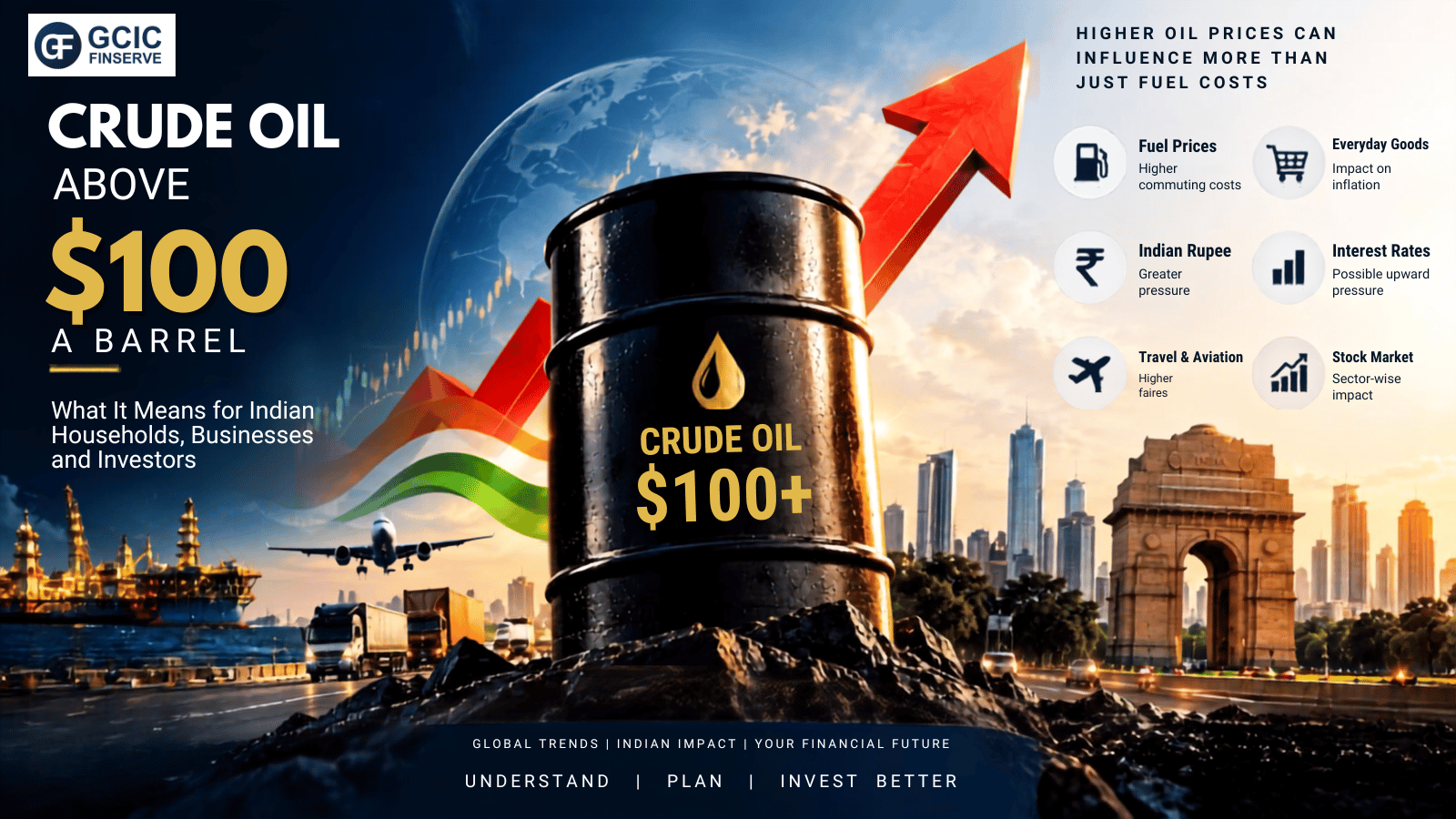
Crude oil above $100 a barrel is back in the financial headlines, and investors are once again watching what higher energy prices could mean for inflation, the rupee, interest rates, and the stock market.
For an everyday investor, however, the bigger question isn’t simply where crude oil is trading today. It is how sustained high oil prices can affect your household expenses, businesses, and investments.
Why Crude Oil Above $100 Matters to Indian Households
India relies heavily on imported crude oil. That means a sustained rise in international oil prices can have wider implications for the Indian economy.
When crude remains elevated for an extended period, the effects can travel through fuel costs, transportation, inflation, the rupee, and interest-rate expectations.
However, this does not automatically mean that the stock market will fall.
Markets respond to several factors at the same time, including corporate earnings, interest rates, global economic conditions, currency movements, and investor sentiment.
The important thing is understanding the potential chain reaction when oil prices remain high.
How Crude Oil Above $100 Reaches Your Wallet
Petrol, Diesel, and Daily Commuting
Fuel is one of the most visible connections between crude prices and everyday life.
If international crude prices remain elevated, fuel-related costs can come under pressure. This can affect not only personal vehicle expenses but also taxis, delivery services, and other forms of transportation.
For households across Delhi NCR, even relatively small increases in recurring expenses can add up over time.
Transportation and Everyday Goods
Before a product reaches a store in Gurugram, Noida, South Delhi, or another part of Delhi NCR, it may pass through several stages of transportation.
Higher energy and logistics costs can increase business expenses. Companies may absorb some of these costs or pass a portion on to consumers.
This is one way higher oil prices can contribute to broader inflationary pressure.
Flights and Travel
Airlines are particularly sensitive to fuel costs because aviation fuel is a major operating expense.
If crude oil remains elevated for an extended period, airlines may face higher costs, which can influence profitability and, depending on market conditions, travel prices.
The Inflation and Interest Rate Connection
This is where the crude-oil story becomes particularly important for investors.
Higher oil prices can increase transportation and production costs across different parts of the economy. If businesses pass these costs on to consumers, inflationary pressure can increase.
Persistent inflation can influence expectations around interest rates.
Higher interest rates can affect:
- Home-loan EMIs
- Business borrowing costs
- Consumer spending
- Corporate investment
- Bond and fixed-income returns
- Equity valuations
So the chain can look something like this:
Higher crude prices → higher input costs → inflationary pressure → interest-rate expectations → impact on businesses and markets
The actual outcome can vary depending on the broader economic environment.
Which Sectors Feel Crude Oil Above $100 the Most?
Not every business is affected in the same way.
Some sectors are more directly exposed to higher energy and transportation costs.
Sectors that may face greater pressure
- Airlines
- Logistics and transportation
- Paint companies
- Certain chemical companies
- Energy-intensive manufacturers
- Some automobile-related businesses
At the same time, some companies may have stronger pricing power or other factors that help offset higher costs.
Oil producers can also respond differently to higher crude prices than oil-consuming businesses.
This is why “crude oil above $100 = stock market fall” is too simplistic.
The real question is
Which companies are affected, and how significantly?
What Crude Oil Above $100 Means for Mutual Fund Investors
If you invest through mutual funds rather than directly buying individual stocks, you may wonder why crude oil matters to your portfolio.
The reason is simple: mutual funds may hold companies across sectors such as:
- Banking
- Technology
- Consumer goods
- Automobiles
- Energy
- Manufacturing
- Infrastructure
Higher oil prices can affect these businesses differently.
Therefore, instead of reacting to a single market headline, investors should look at their actual portfolio, investment horizon, asset allocation and financial goals.
A portfolio review can often provide more useful information than reacting to one day’s movement in crude prices.
The Rupee Angle
Crude oil is traded internationally in US dollars.
When global oil prices rise, India’s import bill can increase. If the rupee is also under pressure against the US dollar, imported oil can become even more expensive in rupee terms.
This can create additional pressure on inflation and India’s external finances.
The broader chain can therefore look like
Crude oil above $100 → higher import costs → currency pressure → inflation concerns → interest-rate expectations → potential impact on businesses and markets
This is not a fixed formula, and several other economic factors influence each stage.
What Should Investors Actually Do?
The first response should be understanding, not panic.
A single headline about crude oil above $100 is rarely a sufficient reason to completely change a long-term investment strategy.
Instead, ask yourself:
- Has my investment horizon changed?
- Is my asset allocation still appropriate?
- Am I overly concentrated in one sector?
- Have my financial goals changed?
- Do I have sufficient liquidity for near-term needs?
- Have the fundamentals of the investments I own changed?
If the answer to these questions is no, reacting purely to an oil-price headline may not improve your investment outcome.
Domestic fuel prices are influenced by multiple factors beyond international crude, including taxes and other components of the pricing structure. For official petroleum-sector data and information, investors can refer to the Petroleum Planning & Analysis Cell (PPAC), Government of India.
GCIC Finserve’s Perspective for Delhi NCR Investors
At GCIC Finserve, we believe financial information should go beyond explaining what happened in the markets.
Investors also need to understand why it matters to their financial goals.
Whether the headline is about crude oil, interest rates, inflation, or a market correction, a long-term financial plan should be built around your goals, risk profile, investment horizon, and overall financial situation rather than short-term market noise.
If you’re an investor in South Delhi, Gurugram, Noida, or the wider Delhi NCR region, reviewing your portfolio periodically can help you understand whether your investments continue to match your financial objectives.
Connect with GCIC Finserve to discuss your financial planning and investment requirements.
FAQs
1. Does crude oil above $100 mean the Indian stock market will fall?
No. Crude oil is one of many factors that influence the stock market. Earnings, interest rates, global economic conditions, currency movements, and investor sentiment also play important roles.
2. How does crude oil above $100 affect petrol prices in India?
Higher international crude prices can increase input costs, but domestic fuel prices also depend on factors such as taxes, refining costs, and other components. Therefore, the relationship is not necessarily one-to-one.
3. Should I change my mutual fund portfolio because crude oil is above $100?
Not automatically. Review your investment goals, risk profile, asset allocation, and the actual holdings of your funds before making significant changes.
4. Which sectors are most affected by high crude oil prices?
Airlines, logistics, transportation, and some chemical, paint, and manufacturing companies can face greater cost pressure. The impact varies by company and its ability to manage or pass on higher costs.
5. Can high crude oil prices affect the Indian rupee?
Yes. Higher oil prices can increase India’s import bill and demand for US dollars, potentially putting pressure on the rupee, although currency movements depend on many other factors as well. Recent market commentary has linked elevated oil prices with pressure on the rupee.
Final Word
Crude oil above $100 isn’t just a global financial headline.
For Indian households and investors, sustained high oil prices can potentially influence fuel costs, inflation, currency movements, interest-rate expectations, corporate profitability, and market sentiment.
But the objective shouldn’t be to predict every movement in the price of oil.
It should be to understand what actually matters for your financial plan.
Plan your investments around your goals—not around the day’s headline.
Disclaimer
This article is intended solely for educational and informational purposes and should not be construed as investment advice. Mutual fund investments are subject to market risks. Please read all scheme-related documents carefully before investing. Investors should consider their financial goals, risk profile and investment horizon and consult an appropriately qualified/registered financial professional where required.