
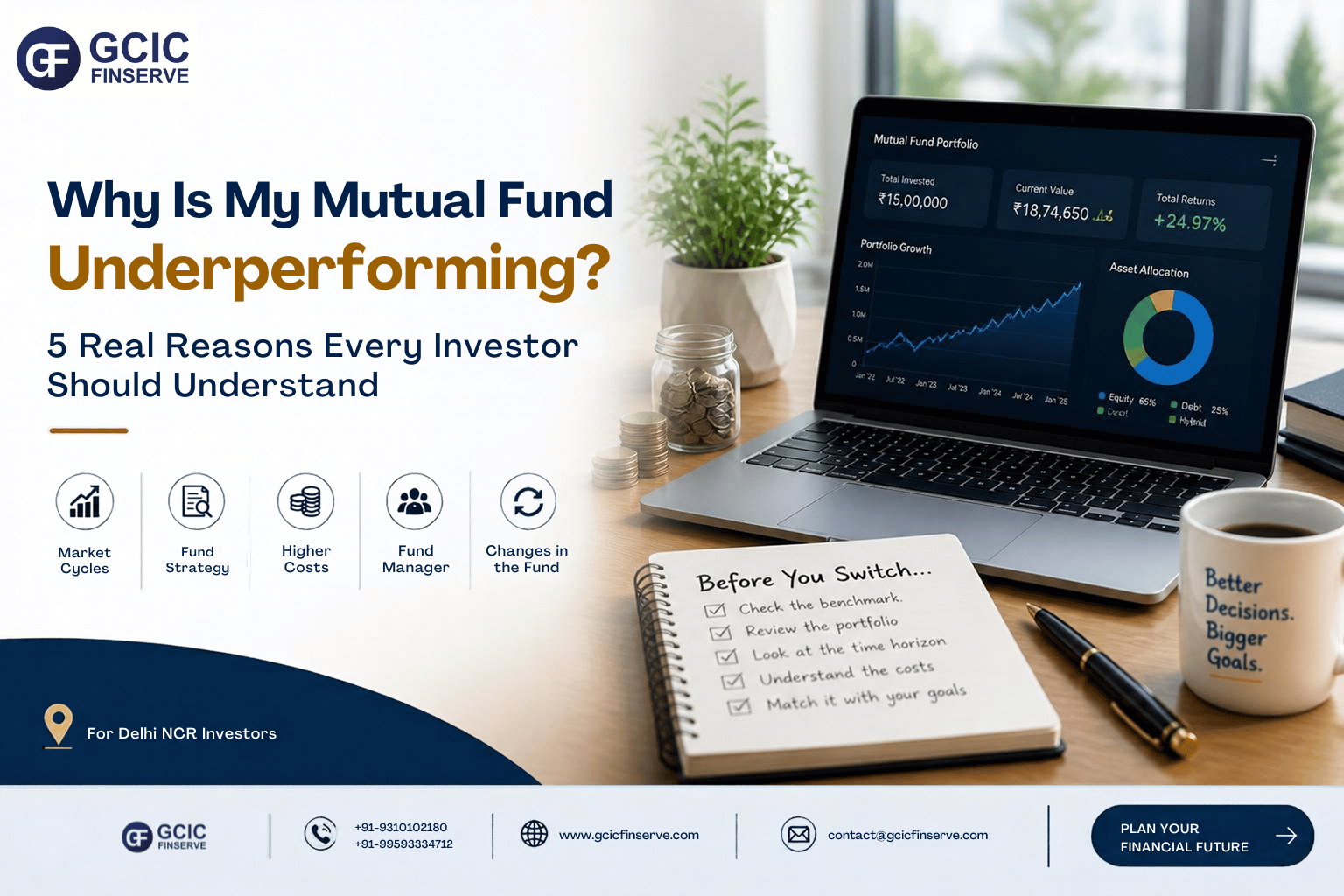

Why is my mutual fund underperforming? It’s the question that hits the moment you spot a friend’s fund or a WhatsApp forward showing higher returns than your own. Across Delhi NCR, this is one of the most common triggers for investors to impulsively switch funds, often without actually understanding what’s behind the gap. Before you make that call, it helps to know that a fund can deliver positive returns and still technically be “underperforming”—and that alone isn’t always a red flag.
What Does “Underperforming” Actually Mean?
Underperformance simply means a fund has delivered lower returns than an appropriate reference point—its benchmark, its category, or a comparable peer—over a specific period. If your fund returned 10% while its benchmark returned 14%, that’s a 4-point gap. But looking at just one period can be misleading, since different investment strategies perform differently across market cycles. A fund trailing today may lead tomorrow once conditions shift—which is exactly why understanding why my mutual fund is underperforming matters more than reacting to a single number.
5 Real Reasons a Mutual Fund Can Underperform
1. Its Investment Style Is Temporarily Out of Favor
A value-oriented fund can lag when growth stocks are leading the market, and a defensive portfolio may not fully participate in a sharp rally. This doesn’t mean the fund manager has erred—it may simply be positioned differently from what the market is currently rewarding.
2. It’s Going Through a Difficult Market Cycle
If the sectors a fund holds significant exposure to fall out of favor, its returns can trail benchmarks and peers for a stretch—particularly relevant for actively managed funds whose positioning differs meaningfully from an index.
3. The Fund Manager’s Calls Haven’t Worked Out
Active management means making decisions that differ from the benchmark. Some work, some don’t. If a fund manager’s decisions consistently fail to add value over a meaningful period, that’s when persistent underperformance deserves closer investigation.
4. Higher Costs Are Eating Into Returns
Expenses reduce what actually reaches investors. Two funds with near-identical portfolios can produce different investor returns purely due to differences in expense ratios—which is exactly why performance should be judged after costs, not just on paper.
5. The Fund Itself Has Changed
Fund managers change, investment processes evolve, and portfolios can end up looking quite different from what you originally signed up for. If the reason you picked the fund no longer holds true, that’s worth attention—even before returns reflect the shift.
Stop Comparing Every Fund to the Nifty
One of the biggest mistakes behind “why is my mutual fund underperforming” panic is comparing every scheme directly to the Nifty 50. A small-cap fund, a debt fund, and a large-cap fund all have completely different mandates, so their performance should be judged against the appropriate benchmark and category—not a single headline index. The real question isn’t “did my fund beat the market?” It’s “Did my fund perform reasonably well relative to what it’s actually designed to compete with?”
How Long Should You Wait Before Judging a Fund?
There’s no universal timeframe that fits every fund. Short-term performance is heavily influenced by market conditions, so a few weak months — or even a year — may not say much about a long-term strategy’s quality. A more meaningful review looks at performance across different market cycles and an appropriate investment horizon. According to AMFI India’s investor education resources, evaluating a fund against its category and benchmark over a longer, relevant period gives a far more accurate picture than a single year’s snapshot.
Should You Switch Your Mutual Fund?
Not simply because another fund performed better recently. Switching purely on recent performance often traps investors in a costly cycle—selling a fund after weakness and buying another right after it has already run up. Instead, first understand why your fund underperformed and whether that reason is likely to persist. If its strategy, management, and risk profile remain appropriate, temporary underperformance may not require any action at all. A review becomes genuinely worthwhile when underperformance is persistent, hard to explain, or accompanied by real changes in fund management or strategy.
GCIC Finserve’s Take for Delhi NCR Investors
At GCIC Finserve, when Delhi NCR clients ask, “Why is my mutual fund underperforming?” we don’t jump straight to a switch—we look at the fund’s benchmark-relative performance, category consistency, portfolio positioning, and whether it’s still serving its original purpose in the portfolio. As an AMFI-registered Mutual Fund Distributor (ARN-272705), our team helps you separate a fund that genuinely needs replacing from one that’s simply going through a normal market cycle.
FAQs
Q1. Why is my mutual fund underperforming the market? It could be due to its investment style being out of favor, sector exposure, costs, fund manager decisions, or changes in the fund’s strategy—not necessarily poor management.
Q2. Should I sell a mutual fund after one year of underperformance? Not necessarily. One year can reflect normal market cycles rather than a genuine problem—compare it against its appropriate benchmark and category first.
Q3. Should I switch to whichever fund has the highest recent returns? Not automatically. Chasing recent performance often means buying high after a fund has already run up—evaluate based on strategy and suitability instead.
Q4. What should I check before replacing an underperforming fund? Its benchmark and category performance, consistency across periods, portfolio positioning, costs, and whether it still fits your original goal and risk profile.
Final Word
The next time you catch yourself asking, “Why is my mutual fund underperforming?” resist the urge to switch immediately. Understand the reason first—market cycle, style, costs, or a genuine change in the fund—and only then decide if action is actually needed. A fund doesn’t need to top the charts every year to remain the right investment for you.
Disclaimer: This article is intended solely for educational and informational purposes and should not be construed as investment advice. Mutual fund investments are subject to market risks. Please review scheme-related documents and consult a registered advisor before investing.